Multi-Location Local SEO: How Businesses Win in 2026
Why Multi-Location Businesses Lose Search Visibility As They Grow
Single-location SEO works like a spotlight: every review, link, and page points at one address, and Google rewards that focus with clear rankings. The moment a second or third location opens, that spotlight has to become several spotlights — and most businesses keep running single-location tactics across a multi-location reality. The result is predictable: duplicate-feeling location pages, inconsistent business listings, and a brand-wide review score that hides one badly underperforming branch.
Multi-location local SEO is the practice of optimizing a business's online presence so that every individual location — not just the brand as a whole — ranks independently in its own local search results. That means a dedicated, unique page and a fully optimized Google Business Profile for every address, not a single homepage trying to represent them all. It's the local-market extension of the same principle behind Generative Engine Optimization: being structured clearly enough that both search engines and AI answer engines can confidently point someone to the right place.
The stakes are real: close to half of all Google searches carry local intent, and most people who run a local search visit a business within the day. For a multi-location brand, losing that moment at even one address is lost revenue at that specific branch — not something a strong flagship location can quietly cover for.
The Real Cost of Treating Every Location the Same
The most common failure pattern isn't a lack of effort — it's applying one strategy uniformly across markets that don't behave the same way. A flagship location in a competitive city and a newer location in a quieter market need different keyword targets, different content depth, and different investment levels. Treating them identically either overspends where it isn't needed or underfunds the location that's actually losing ground to local competitors.
This is exactly the friction Cosnet found when working with Sanctuary Day Spa, a multi-location wellness brand operating across Canada. Customers needed a consistent way to discover services and locations through high-intent local search, the brand needed to feel unified without going generic city to city, and — critically — all of that visibility had to convert into actual appointments, not just traffic.
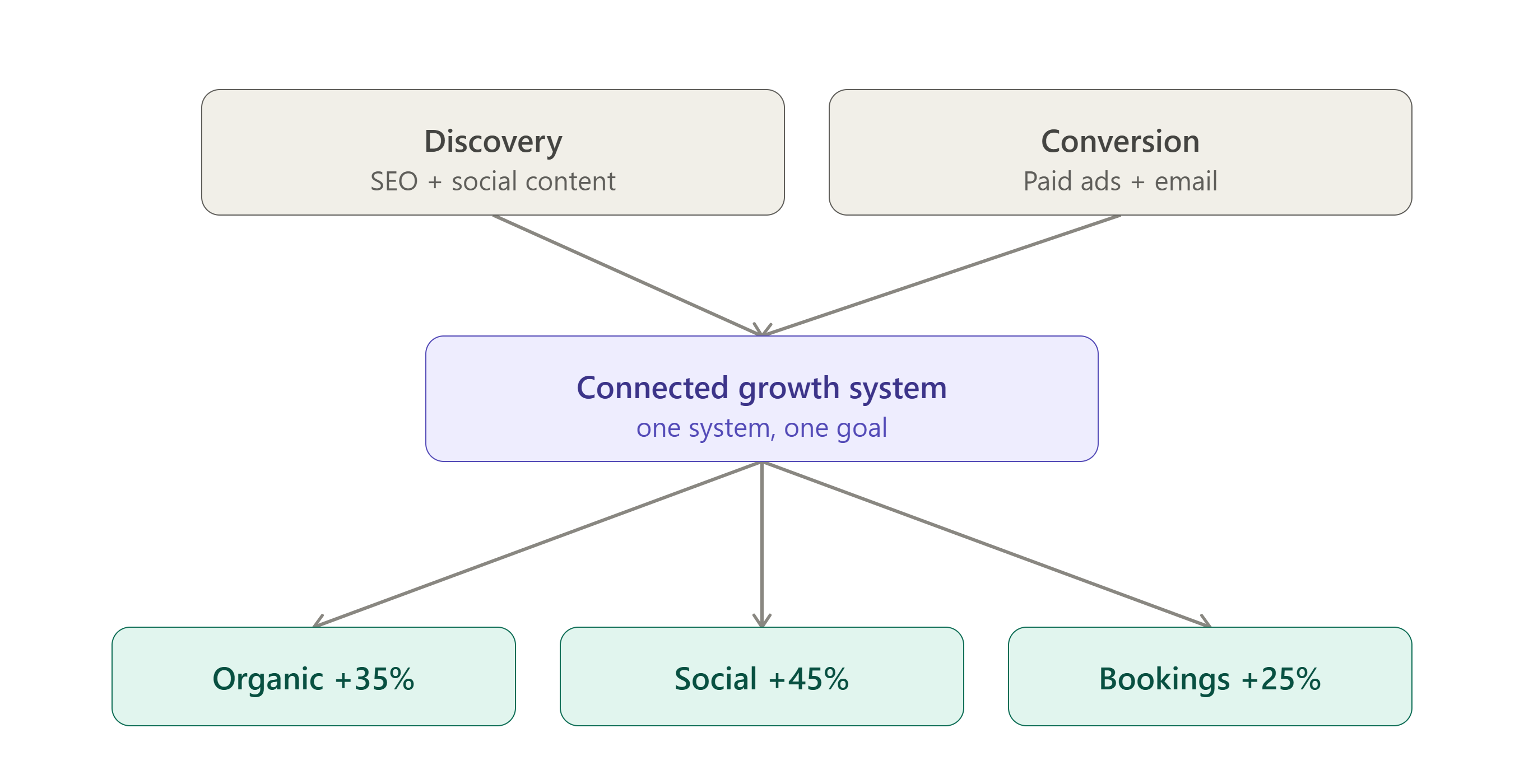
The engagement, in full: Cosnet mapped three specific pressure points before touching a single tactic: local search visibility (could the right customer find the right location?), multi-location brand consistency (did the experience feel unified without every location reading like a copy-paste of the last?), and booking conversion (did website, paid, social, and email actually move someone from interest to an appointment, or just generate impressions?). From there, the solution was built as four connected workstreams rather than four separate projects: SEO and service content to strengthen organic discovery for treatments and locations, a structured social content system for consistency across the brand, conversion-focused PPC on Google and Meta to connect high-intent audiences to the right booking journey, and email plus reporting to support retention and continuous optimization. The delivery process ran through location-and-audience discovery, channel and content strategy, campaign and asset production, launch and booking optimization, and monthly reporting and iteration — a repeatable cycle, not a one-time campaign.
Where the engagement stands today: This case study reflects the strategy and stack Cosnet built for Sanctuary Day Spa at the time — and it worked, producing the results below. But local search itself has moved on since, and if Cosnet were scoping this same brief today, the core structure (unique location pages, per-address GBP discipline, connected paid/social/email) would stay, while several things would be layered on top. See "How We'd Approach This With Our Current Playbook" below for what that looks like in practice.
What Actually Moves The Needle: Location Pages And Google Business Profiles
Two assets carry most of the weight in multi-location SEO, and they work together rather than separately.
Unique, location-specific pages: Generic pages with only the city name swapped don't rank — search engines can tell. Each location page needs genuinely local content: the specific services offered there, real local proof points, and enough original substance (not templated filler) to read as its own page rather than a copy.
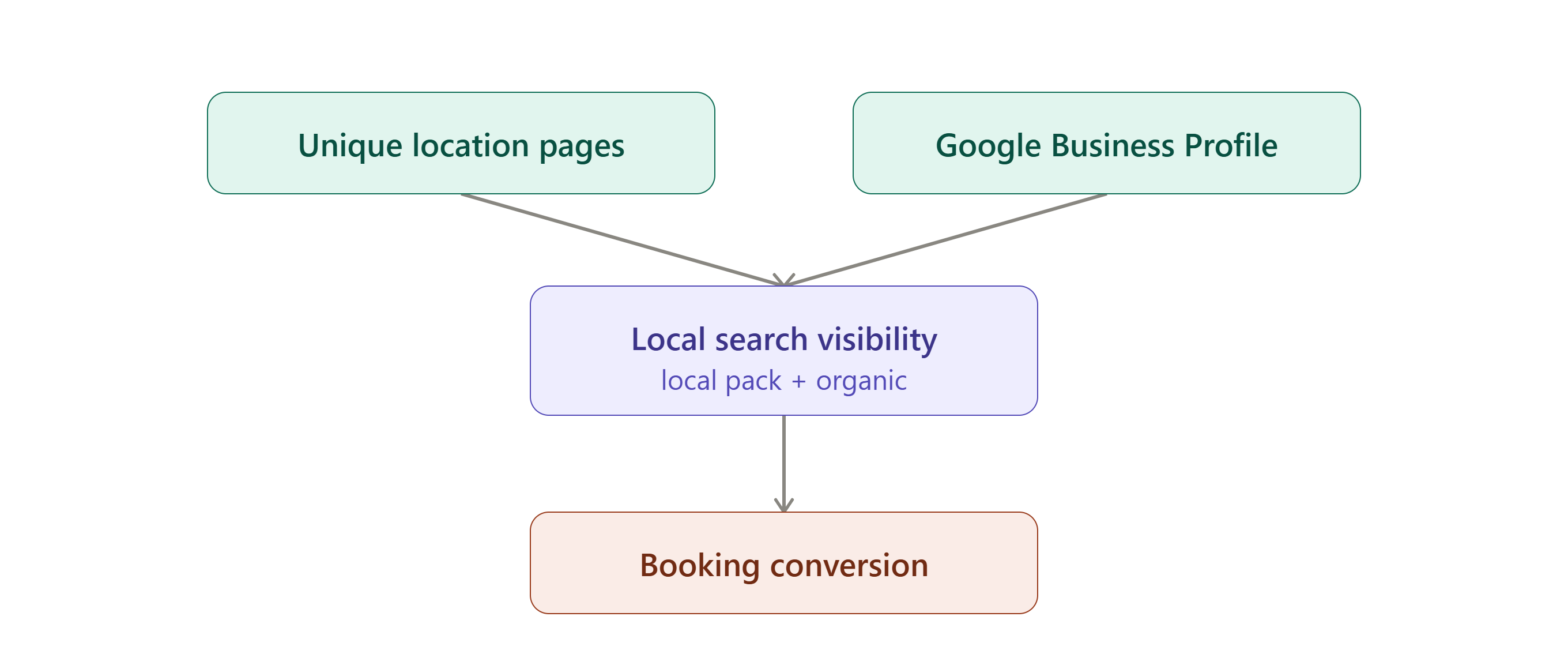
A fully optimized Google Business Profile per address: Every physical location needs its own profile — never consolidated into one brand-level listing. GBP signals, including proximity and category accuracy, carry the largest share of ranking weight in the local map pack, which is often the first thing a nearby searcher sees.
Consistency matters just as much as accuracy. A mismatched business name, address, or phone number across even one directory listing can quietly suppress rankings for that entire location, and a strong brand-wide review average can hide a single branch that's actually driving customers away.
For Sanctuary Day Spa, this meant pairing technical SEO fixes with useful, location-aware content to strengthen organic discovery for both treatments and individual locations — not a one-time cleanup, but a structure built to hold as the brand grew.
Local SEO Alone Doesn't Fill A Calendar — Connect It To Conversion
Visibility that doesn't lead anywhere is a vanity metric. The businesses that actually grow from local search connect SEO to the rest of the funnel: paid campaigns that meet high-intent searchers at the right moment, social content that keeps the brand present between visits, and email that brings past customers back.
That's the model Cosnet built for Sanctuary Day Spa: SEO and content to strengthen discovery, a structured social calendar for consistency across locations, conversion-focused Google and Meta campaigns to connect high-intent audiences with the right booking journey, and email plus analytics to support retention and ongoing optimization. It's the same connected-channel thinking behind wellness-sector plays like on-demand massage and spa innovation, where discovery and booking have to work as one system, not separate efforts. Nothing ran in isolation — every channel fed the same goal, which was turning interest into a booked appointment.
The results speak to what a connected system does versus a collection of disconnected tactics: 35% growth in organic visibility, 45% growth in social presence, and a 25% increase in bookings.
How We'd Approach This With Our Current Playbook
The structure behind Sanctuary Day Spa's results still holds — unique location pages, disciplined per-address Google Business Profiles, and channels that reinforce each other rather than running in isolation. That foundation doesn't go out of date. But local search itself looks different now, and running this same brief today, Cosnet would layer in a few things that weren't standard practice at the time:
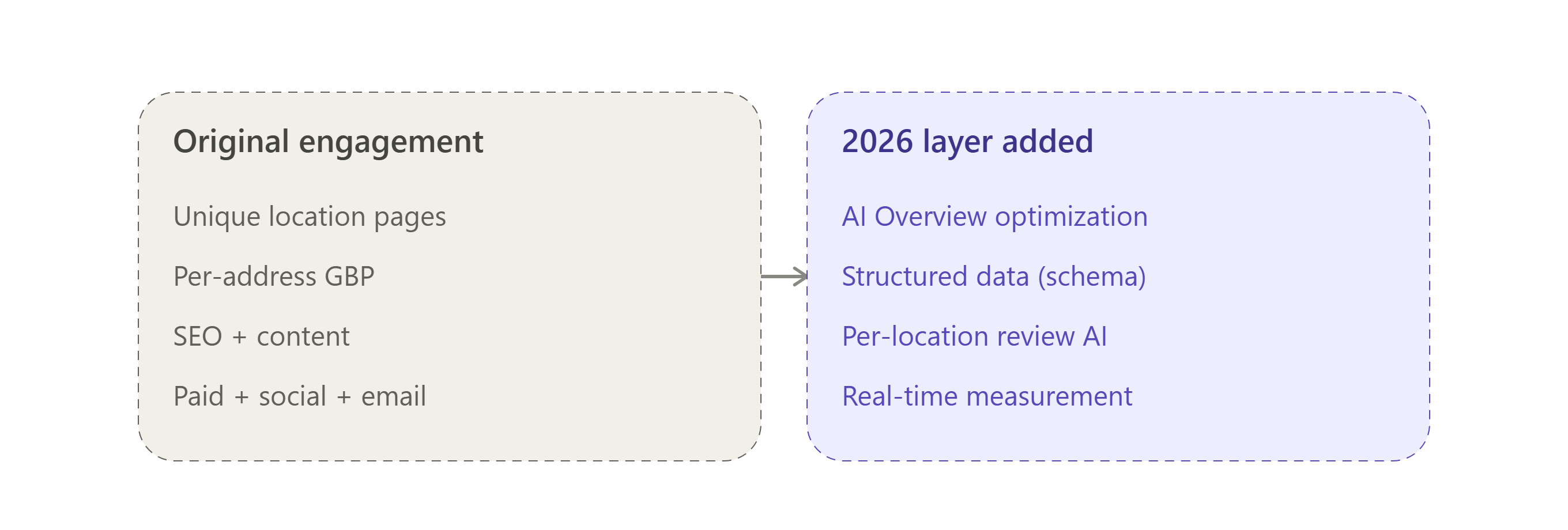
- Optimizing for AI Overviews and AI answer engines, not just the blue links:
A growing share of local searches now surface an AI-generated answer before any ranked list. That means structuring location pages to directly answer common questions (hours, specific treatments, booking steps) in clear, quotable language AI systems can lift, alongside the classic keyword and schema work. - Structured data as a first-class asset, not an afterthought:
Location, service, FAQPage, and review schema help both traditional crawlers and generative engines understand exactly what each location offers — increasingly a prerequisite for showing up in AI-driven local answers, not just a minor technical checkbox. - Per-location review intelligence:
Rather than tracking one brand-wide rating, actively surfacing and responding to the specific location dragging down the average — since that's usually also the location quietly losing the most bookings.
- Semantic and entity-based keyword targeting:
Instead of one keyword per page, building each location page around a topic cluster and related search intents, which holds up better as search engines lean more on understanding meaning and context rather than exact-match phrases. - Tighter, real-time measurement loops: Connecting Google Business Profile insights, location-level rankings, and booking data on a continuous cycle instead of a monthly rollup, so budget can shift toward an underperforming location before it shows up as a revenue problem.
None of this replaces the original structure it builds on it. A brand running the Sanctuary Day Spa playbook today with these layers added would be positioning itself not just for the local pack, but for however the next generation of AI-driven local search actually gets discovered.
How To Apply This To Your Own Locations
- Audit every location individually, not the brand as a whole. A healthy overall average can be masking one location that's actively losing visibility and business.
- Give every address its own page and its own Google Business Profile — no exceptions, no consolidation.
- Lock down NAP consistency (name, address, phone) across your website, directories, and every citation before investing further in content or ads.
- Connect the channels. SEO earns the visibility; paid, social, and email are what turn that visibility into bookings and repeat visits.
- Track performance by location, not just in aggregate, so budget and effort go where they're actually needed.
FAQ's
- What is multi-location local SEO?
Multi-location local SEO is the practice of optimizing a business's online presence so each individual physical location ranks independently in its own local search results, rather than relying on one brand-wide page or profile. - How is multi-location SEO different from single-location local SEO?
Single-location SEO focuses every signal — content, links, reviews — on one address. Multi-location SEO has to do that same job separately for every location, without one branch cannibalizing another's rankings in Google AI Overviews or the local map pack. - Do I need a separate Google Business Profile for each location?
Yes. Every physical location needs its own fully optimized Google Business Profile consolidating locations into a single listing actively hurts visibility for each one. - Should each location have its own website page, or can they share one?
Each location needs its own dedicated page with unique, locally relevant content — generic pages with only the city name swapped are treated as thin content and rarely rank. - How do I stop my locations from competing with each other in search results (keyword cannibalization)?
Give each location page a distinct, non-overlapping keyword focus tied to its own services and neighborhood, and keep internal linking structured so location pages point to each other logically rather than duplicating the same target terms. - How long does multi-location local SEO take to show results?
Most businesses see initial Google Business Profile visibility improve within weeks, while meaningful ranking and booking gains typically build over three to six months of consistent execution across location pages, listings, and content. - What is NAP consistency and why does it matter for multiple locations?
NAP consistency means your business Name, Address, and Phone number match exactly across your website, directories, and citations for every location; even one mismatch can suppress rankings for that specific address. - Can local SEO alone increase bookings, or do I need paid ads too?
SEO builds sustainable visibility, but pairing it with paid campaigns, social, and email — as in Sanctuary Day Spa's results — tends to convert that visibility into bookings faster and more reliably than SEO alone. See how conversion-focused paid campaigns support the same goal. - How do online reviews affect local search rankings for multiple locations?
Reviews are one of the strongest local ranking signals, and they need to be managed per location rather than as a single brand-wide average — one underperforming location can quietly drag down bookings even while the brand's overall rating looks healthy. - How do I measure local SEO performance across multiple locations?
Track rankings, Google Business Profile insights, and website conversions by individual location rather than in aggregate, so you can see which specific address is gaining or losing visibility and direct budget accordingly.
Multi-location growth shouldn't mean diluted visibility. With the right structure — unique location pages, disciplined Google Business Profile management, and channels that work together instead of in isolation — every address can compete and win in its own market, the way Sanctuary Day Spa's locations did across Canada.
Ready to see what a connected local search strategy could look like for your locations? Talk to our Experts.