Real-Time Supply Chain Visibility: The New Standard
Real-time supply chain visibility stopped being a differentiator the moment a single grounded ship reminded the world how blind global logistics actually was. When the Ever Given wedged itself across the Suez Canal in 2021, it halted an estimated $9.6 billion in trade every single day it sat there — and a large share of the affected cargo owners couldn't say, with any precision, where their containers were or what condition they were in while the crisis unfolded. That gap between "the shipment left port" and "the shipment is fine" is exactly what AI logistics use cases built on modern IoT infrastructure are now closing — and it's why item-level, continuous monitoring has replaced periodic milestone updates as the baseline expectation for enterprise logistics platforms, not an advanced feature reserved for a handful of premium shippers.
This shift is now measurable at the industry level. Visibility has moved from a technical concern owned by operations teams to a boardroom strategic imperative, and 89% of logistics companies now name visibility a key operational priority. What follows is both the architecture behind that shift and a working proof point: a live Cosnet-built platform currently tracking over 15,000 containers across 10+ countries at 99.5% monitoring accuracy.
Why Real-Time Supply Chain Visibility Replaced "Track and Trace"
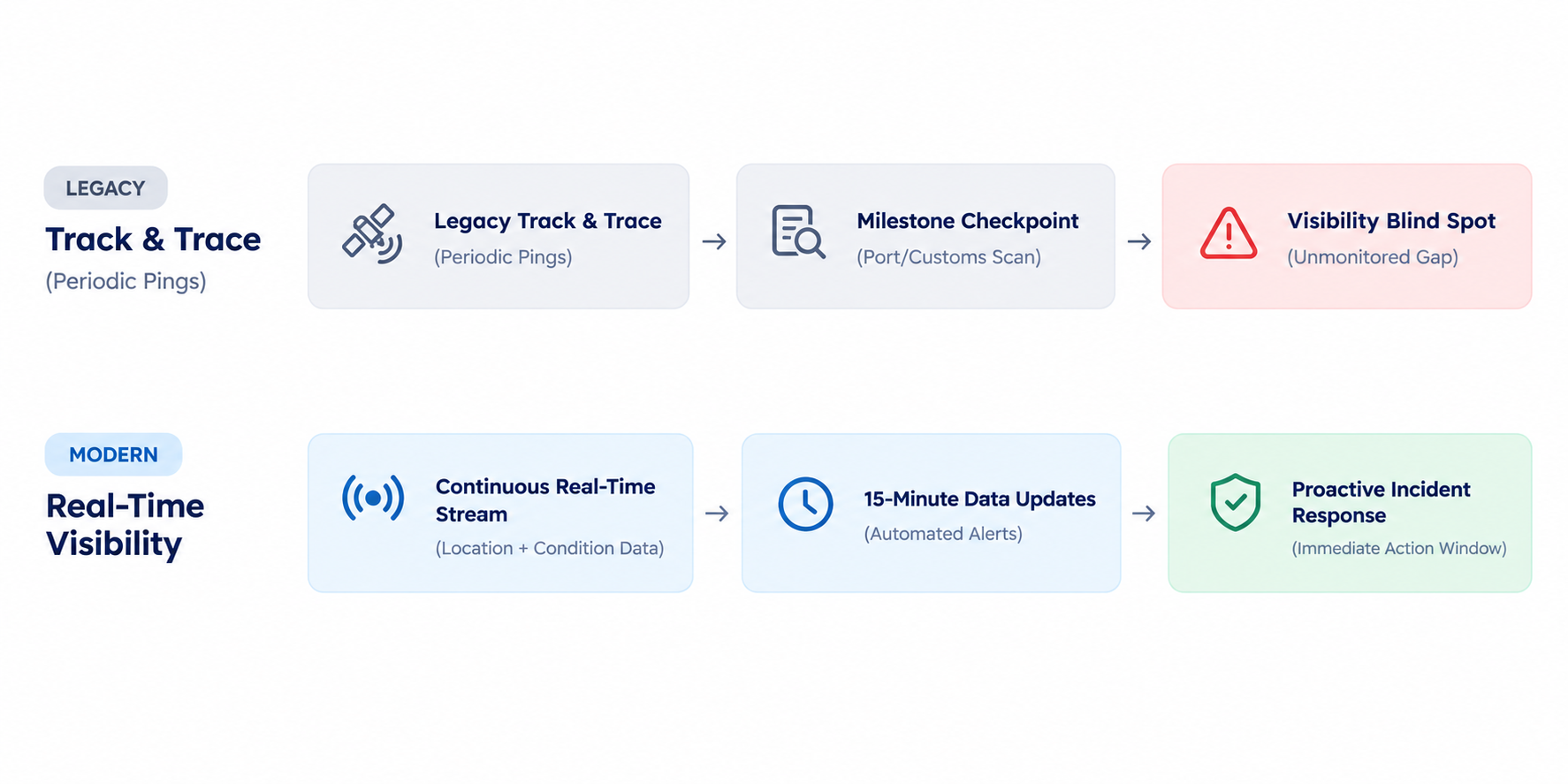
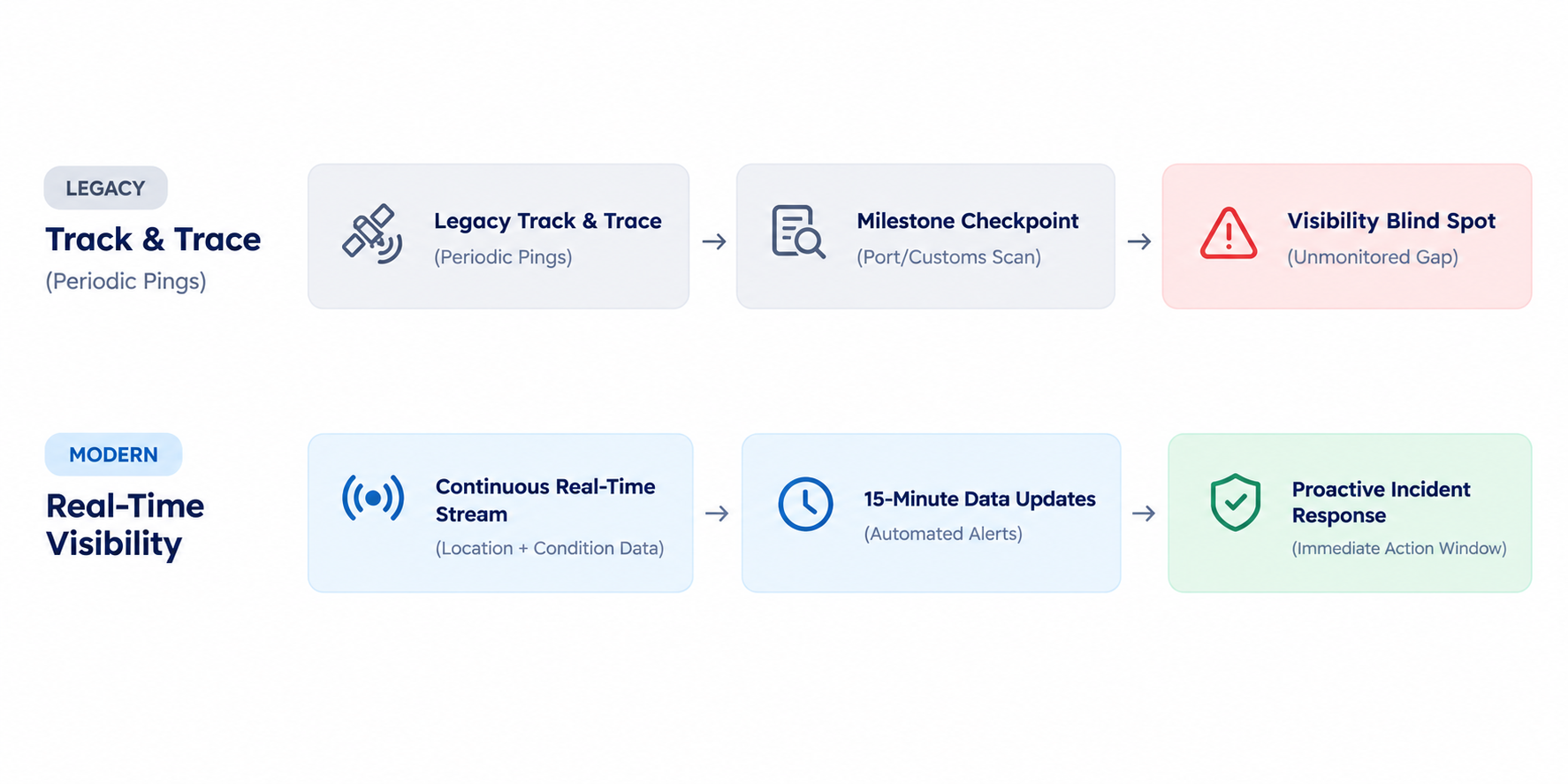
"Track and trace" was built for a world where a shipment's status was a lookup, not a stream. A carrier scanned a container at a handful of checkpoints — port departure, customs clearance, port arrival — and the shipper filled in the gaps with assumptions. That model was tolerable when supply chains were simpler and delays were rare enough to absorb. It is no longer tolerable at current scale, complexity, or risk exposure.
The Cost of Blind Spots in Transit
A milestone-based system tells you where a container was several hours ago, not where it is or what state it's in right now. For temperature-sensitive cargo, a multi-hour blind spot can mean spoiled product before anyone knows there's a problem. For high-value freight, it means a tampering event or route deviation goes undetected until the container reaches its next scheduled checkpoint — by which point the response window has already closed. The Suez blockage made this failure mode visible at a macro level; day-to-day, it plays out constantly at the individual shipment level, just with less media attention.
From Periodic Pings to Continuous Monitoring
The industry response has been a structural one, not a cosmetic upgrade. Item-level visibility — tracking and condition data at the level of the individual container or asset, rather than an aggregated "shipment status" — has been identified as one of the defining dynamics reshaping supply chains through 2026. Major ocean carriers are acting on this at fleet scale: Hapag-Lloyd has already equipped more than two-thirds of its dry container fleet with IoT tracking devices, and modern container tracking systems now report position updates as frequently as every 15 minutes, with automated alerts for route deviation or tampering events layered on top. That update cadence — not a daily or twice-daily ping — is what "real-time" now actually means in an enterprise logistics contract.
What Actually Makes Real-Time Visibility Work
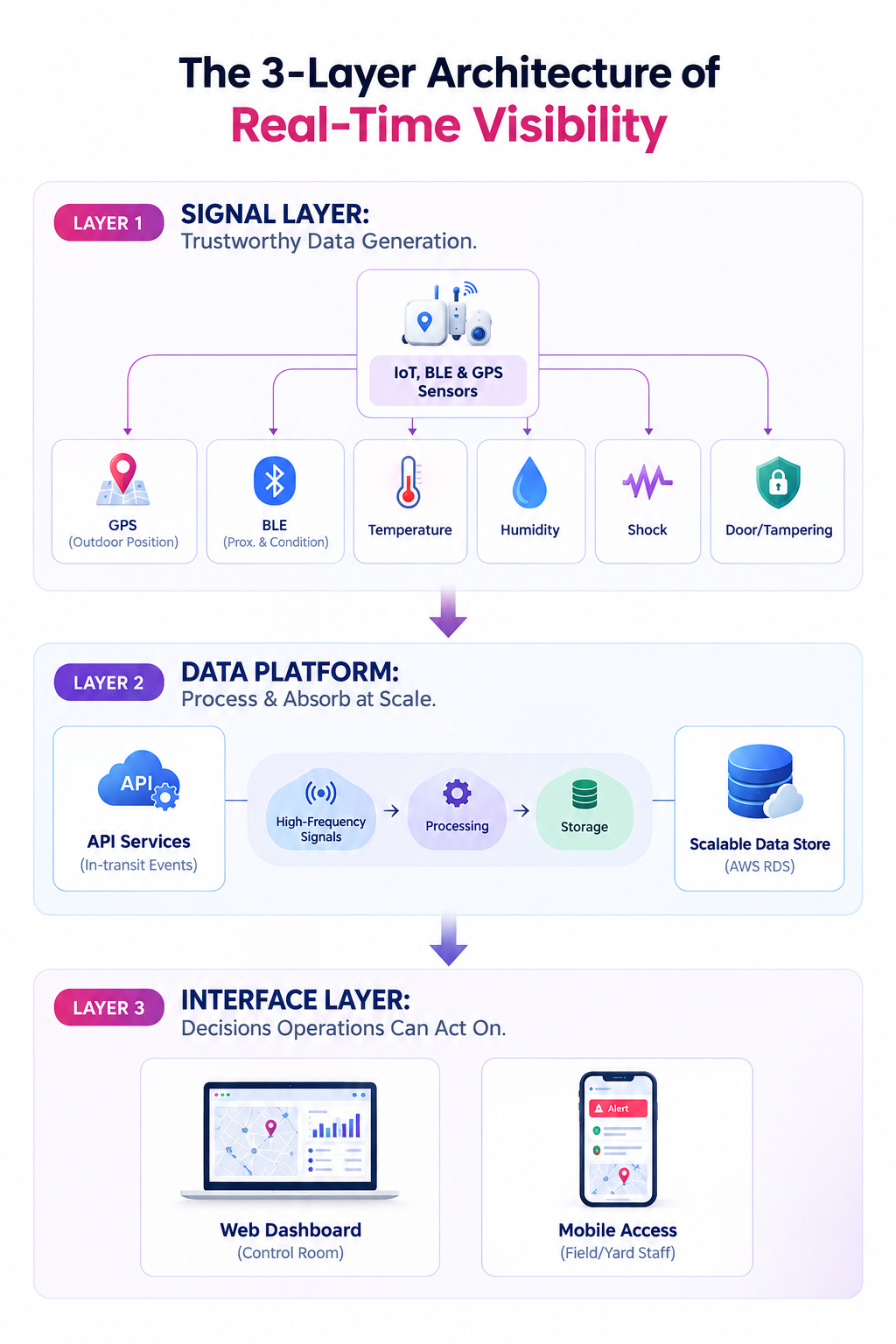
Real-time supply chain visibility isn't one product — it's three layers working together: a signal layer that generates trustworthy data, a data platform that can absorb and process that data at scale, and an interface layer that turns raw signals into decisions operations teams can act on. Miss any one layer and the system degrades back into disconnected data collection, which is functionally the same blind-spot problem as track-and-trace, just with more sensors attached.
The IoT, BLE, and GPS Signal Layer
GPS handles outdoor, long-haul positioning. Bluetooth Low Energy (BLE) beacons handle short-range, low-power proximity and condition sensing — useful inside ports, warehouses, and yards where GPS signal degrades or drains battery unnecessarily. Combining the two gives continuous location awareness without trading off coverage against device battery life, one of the harder constraints in fleet-scale IoT deployments. Increasingly, this layer is expected to report more than location: temperature, humidity, shock/vibration, and door-open events are now standard for cold-chain and high-value cargo monitoring, not optional add-ons.
Cloud Data Architecture at Scale
Device signals are only useful if the backend can ingest, process, and store them reliably as fleet size grows from hundreds to tens of thousands of assets across multiple geographies. That means API services built for high-frequency event ingestion and a data layer designed for both transactional integrity and long-term query performance — the same discipline that underpins how machine learning enhances supply chain efficiency once historical IoT data starts feeding predictive models rather than just dashboards.
Operational Dashboards and Field Access
Raw telemetry only helps once it's rendered as something a team can act on in seconds — a map view, a status flag, an exception alert. Desktop dashboards serve control-room and back-office teams; mobile access matters just as much for field and yard staff who aren't at a workstation when a container needs attention. A platform that solves only one of these misses half its actual users.
The Smart Container Case Study
Smart Container, an IoT logistics company based in the United Kingdom, needed a digital system built to receive live device data, present container location and condition clearly, and support operational teams through dependable web and mobile tools. Cosnet delivered IoT product design, a web application, Android development, and the cloud data platform underneath all of it — built as, in the case study's own words, "a connected experience, not a collection of isolated features."
The Challenge
Three constraints defined the engagement. First, live device integration: IoT hardware, BLE, and GPS signals needed to flow reliably into the platform without data loss or delay. Second, operational visibility: teams needed understandable real-time views, not disconnected raw data feeds they'd have to interpret manually. Third, scalable monitoring: the system had to support a growing number of containers, users, and countries without a redesign every time the fleet expanded.
The Solution
Cosnet built four connected components. A real-time tracking dashboard gives operations teams a web interface to monitor container location, condition, and activity. An Android application gives field users live tracking and status access away from desktop operations. The IoT, BLE, and GPS integration layer provides the actual signal data driving accurate monitoring and event awareness. And a scalable cloud data layer — Node.js services paired with AWS RDS — handles data processing, storage, and continued platform growth as the fleet expands.
Delivery Process
The engagement followed five phases: device and workflow discovery, data and platform architecture, web and Android delivery, IoT integration and testing, and deployment, monitoring, and scale — run on an Agile delivery model with Jira for tracking.
The Results
The platform now tracks 15,000+ containers, holds 99.5% monitoring accuracy, and operates across 10+ countries. The impact goes beyond the headline numbers: better shipment visibility across operations, faster exception response when something goes wrong in transit, and an architecture built for international scalability rather than a single-market ceiling. This is a direct, working answer to the item-level visibility standard the industry is now converging on — not a theoretical framework.
How We'd Approach This Today
The Smart Container engagement's core architecture — an IoT/BLE/GPS signal layer feeding a scalable cloud data platform with real-time dashboards on top — still holds up as the right foundation. What's changed since is what gets layered on top of that IoT data once it's flowing reliably.
The most significant addition is AI-driven predictive insight. Once historical and real-time IoT data sit in a structured cloud layer, machine learning can move a platform from reporting what happened to anticipating what's likely to happen next — flagging probable port delays, demand spikes, or supplier bottlenecks before they show up as a missed milestone, echoing the same shift already underway in computer vision applications for predictive maintenance across logistics.
Condition monitoring is the second area we'd push further. Cold-chain shipments in particular now warrant sensor coverage well beyond location — temperature, humidity, shock/vibration, and door-tampering detection are increasingly baseline expectations for pharmaceutical, food, and other temperature-sensitive freight, not premium add-ons.
Worth being direct about the real friction points, rather than presenting this as solved: connectivity gaps in remote or shielded indoor environments, device battery life traded off against reporting frequency, legacy ERP/WMS integration that's rarely a clean API handshake, and data fragmentation where carriers, forwarders, and customers each hold a different partial view of the same shipment. None of these are reasons to avoid building — they're reasons to design for graceful degradation and phased rollout rather than a flawless-signal assumption.
How to Apply This to Your Own Logistics Operation
Moving from track-and-trace to genuine real-time visibility rarely needs a full platform rebuild on day one. A phased approach de-risks the investment:
Start with a signal audit. Confirm what your current tracking actually reports — location only, or location plus condition — and how frequently it updates.
Pilot on a defined lane or fleet segment before full rollout, so integration issues surface at small scale.
Build the cloud data layer for growth from the start, not just current volume — retrofitting scalability later costs more than architecting for it upfront.
Decide early whether AI-driven prediction is in phase one or a deliberate phase two — bolting predictive models onto a data layer that wasn't designed for it is a common, avoidable rework cost.
Plan for legacy integration explicitly — it's consistently where real-world timelines slip.
FAQ's
Q1: What is real-time supply chain visibility?
A: Real-time supply chain visibility is the continuous, item-level monitoring of a shipment's location and condition using connected devices, replacing periodic status updates with a live, ongoing data stream. It allows operations teams to see where a shipment is and what state it's in at any given moment, not just at scheduled checkpoints.
Q2: How does IoT container tracking work?
A: IoT container tracking works by attaching connected devices to containers that transmit location (via GPS) and short-range condition data (via BLE) to a cloud platform, where the data is processed and displayed on operational dashboards. Additional sensors can capture temperature, humidity, and shock or tampering events alongside location.
Q3: Why is real-time visibility important in logistics?
A: Real-time visibility is important because it closes the gap between when a problem occurs — a delay, a route deviation, a condition breach — and when a team can respond to it. Without it, operations teams only learn about issues after the fact, at the next scheduled checkpoint, by which point the response window has often already closed.
Q4: What's the difference between track-and-trace and real-time visibility?
A: Track-and-trace reports a shipment's status at fixed checkpoints, giving a snapshot of where it was hours or days ago. Real-time visibility provides a continuous data stream showing where a shipment is and what condition it's in right now, with automated alerts for exceptions as they happen.
Q5: How often do IoT tracking devices update location data?
A: Modern IoT container tracking systems commonly report location updates as frequently as every 15 minutes, with additional automated alerts triggered immediately by events like route deviation or tampering. This is a significant shift from older systems that reported only at major checkpoints.
Q6: Can IoT sensors monitor container condition, not just location?
A: Yes — modern IoT sensors can monitor temperature, humidity, shock and vibration, and door-open or tampering events in addition to GPS location. This condition-monitoring layer is increasingly expected as standard for cold-chain and high-value cargo, not sold as a separate premium feature.
Q7: What technologies are used for real-time container tracking?
A: Real-time container tracking typically combines GPS for long-range location, BLE (Bluetooth Low Energy) for short-range proximity and condition sensing, backend services (commonly Node.js-based APIs) for processing device data, and scalable cloud databases such as AWS RDS for storage and growth. Web dashboards and mobile apps sit on top as the interface layer for operations teams.
Q8: How accurate is IoT-based shipment monitoring?
A: IoT-based shipment monitoring can reach very high accuracy at scale — Cosnet's Smart Container platform, for example, maintains 99.5% monitoring accuracy across more than 15,000 tracked containers in 10+ countries. Accuracy at this level depends on reliable device integration, redundant signal sources (GPS plus BLE), and a data platform built to process high-frequency events without loss.
Q9: What are the biggest challenges in IoT supply chain visibility?
A: The main challenges are connectivity gaps in remote or indoor environments, device battery life constraints against reporting frequency, integration complexity with legacy enterprise systems like ERP and WMS, and data fragmentation where different stakeholders each hold a partial view of the same shipment. These are engineering and integration challenges to design around, not reasons the technology doesn't work.
Q10: Is AI used alongside IoT for supply chain visibility?
A: Yes — AI is increasingly layered on top of IoT data to move platforms from reporting current status to predicting what's likely to happen next, such as forecasting port delays, demand spikes, or supplier bottlenecks from historical and real-time signal data. This predictive layer depends on having a cloud data architecture already capturing clean, structured IoT data to train on.
The Ever Given didn't create the visibility problem in global logistics — it just made it impossible to ignore. Platforms like the one built for Smart Container show what the fix actually looks like in production: continuous, item-level monitoring at real fleet scale, not a dashboard promise. If your operation is still running on milestone pings and manual status checks, the gap between that and where the industry standard now sits is closing fast.
Ready to see what real-time visibility could look like for your logistics operation? Talk to our Experts.