

Most B2B enterprise brands do not lose search visibility because their content is poorly written. The reality is far more structural: companies are losing ground because the software answering their prospects’ questions has fundamentally transformed. With the rise of AI-driven search, executive teams are forced to rethink how Google’s AI Overviews change SEO mechanics and reshape user discovery. To maintain a modern market presence, enterprise leaders must pivot away from legacy keyword tactics and transition toward a dedicated strategy for Generative Engine Optimization (GEO).
For nearly two decades, the digital playbook was simple: optimize your website for target keywords, build backlink profiles, and wait for Google to send users to your URL. But in 2026, the traditional search funnel has completely fragmented. Buyers are no longer browsing lists of blue links; they are asking complex questions directly to Large Language Models (LLMs) like ChatGPT, Perplexity, Gemini, and Google AI Overviews—and receiving singular, consolidated answers.
This structural pivot is why traditional search engine optimization is no longer enough. To capture market share in an AI-driven digital economy, brands must learn how to make their assets highly retrievable for these new cognitive engines.
Here is what GEO means for your business, how the underlying technology operates, and how to position your company to be the definitive solution cited by AI platforms.
The Shift from SEO to GEO: Why the Rules Have Changed
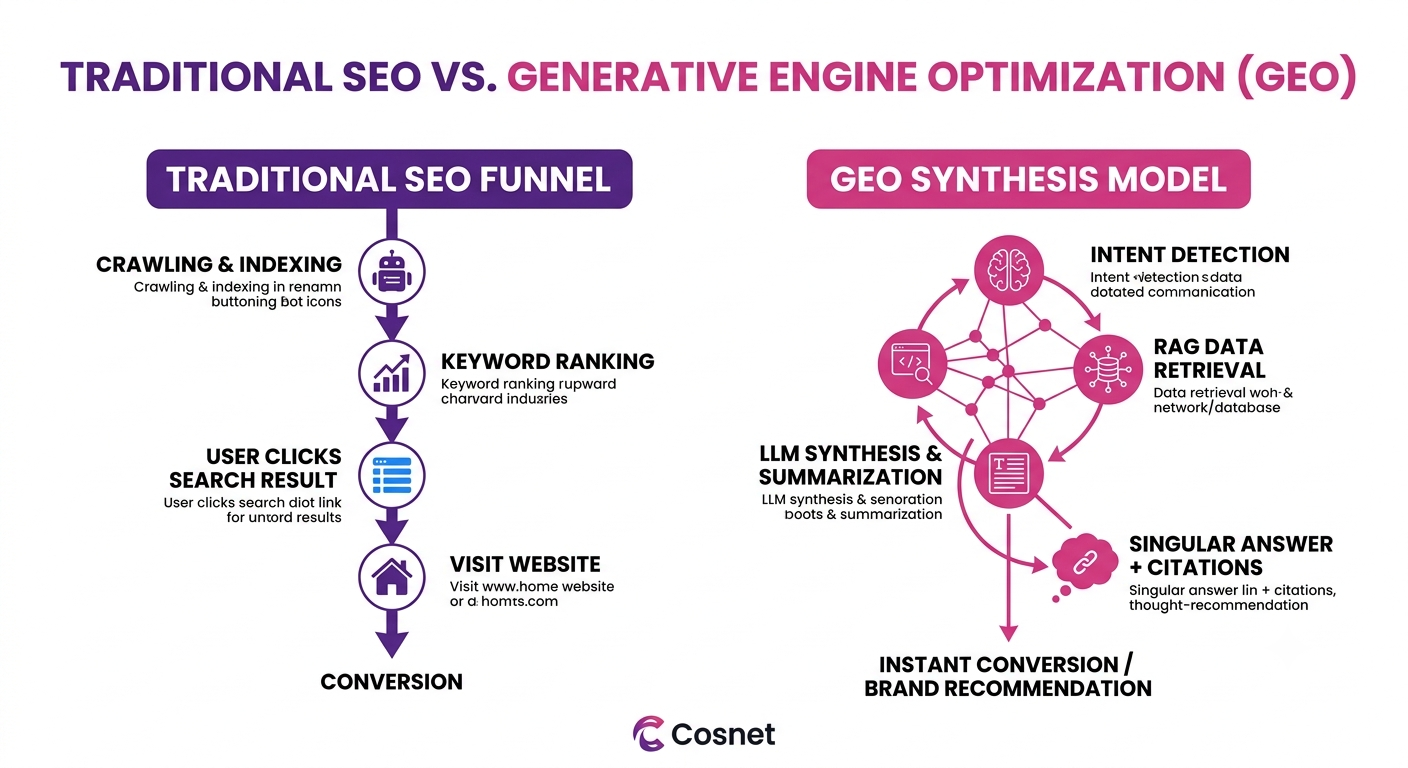
Traditional SEO was built around indexation and ranking algorithms. The objective was to make a webpage easy for a crawler to read so that a search engine could rank it higher in user-facing query lists. Generative Engine Optimization shifts the focus from indexing lists to synthesizing concepts.
When an enterprise buyer uses an AI search assistant, the engine does not perform a static keyword search. Instead, it processes the intent, queries its internal parameters and live indices simultaneously, pulls information from dozens of disparate digital sources, and surfaces a single, highly nuanced response complete with source citations.
Because of this change, if your brand is not structured to be pulled into that generative synthesis, your business becomes functionally invisible to a massive segment of your target market.
How AI Search Engines Source and Cite Business Data
To optimize for generative engines, you must first understand how their underlying retrieval-augmented generation (RAG) loops work. When a user inputs a high-intent commercial prompt—such as “Which enterprise logistics software integrates natively with SAP and handles dynamic multi-carrier routing?”—the AI search engine goes through three synchronized operational steps:
- Intent Extraction: The platform decodes the structural parameters of the prompt, bypassing conversational filler to isolate the exact constraints (e.g., SAP integration, multi-carrier routing).
- Contextual Retrieval: The engine queries live web partitions to find data tables, brand documentation, industry case studies, and customer sentiment tables that match those precise constraints.
- Synthesis & Citation Integration: The engine compresses the retrieved information into a narrative answer. It then applies citation tags directly onto the key phrases or brand recommendations it pulled from external sites.
Failing to design your digital footprint around this workflow means missing out entirely on top-of-funnel discovery. Enterprise leaders must keep a close eye on the GenAI trends reshaping search to ensure their digital assets stay visible within these emerging RAG synthesis cycles.
The 4 Pillars of a 2026 GEO Strategy
GEO is not about exploiting algorithmic loopholes or stuffing keywords into headers. It requires building deep informational authority that AI models can trust. A resilient GEO framework relies on four core operational pillars:
1. Citation Optimization via Technical Grounding
AI engines prioritize structural data and highly factual, verifiable claims over marketing fluff. To be cited, your content must use precise tables, clear data structures, and transparent definitions. If you claim your product scales operations, you must provide the exact parameters—such as metrics, APIs utilized, and concrete technical definitions—that the engine can extract to build its response.
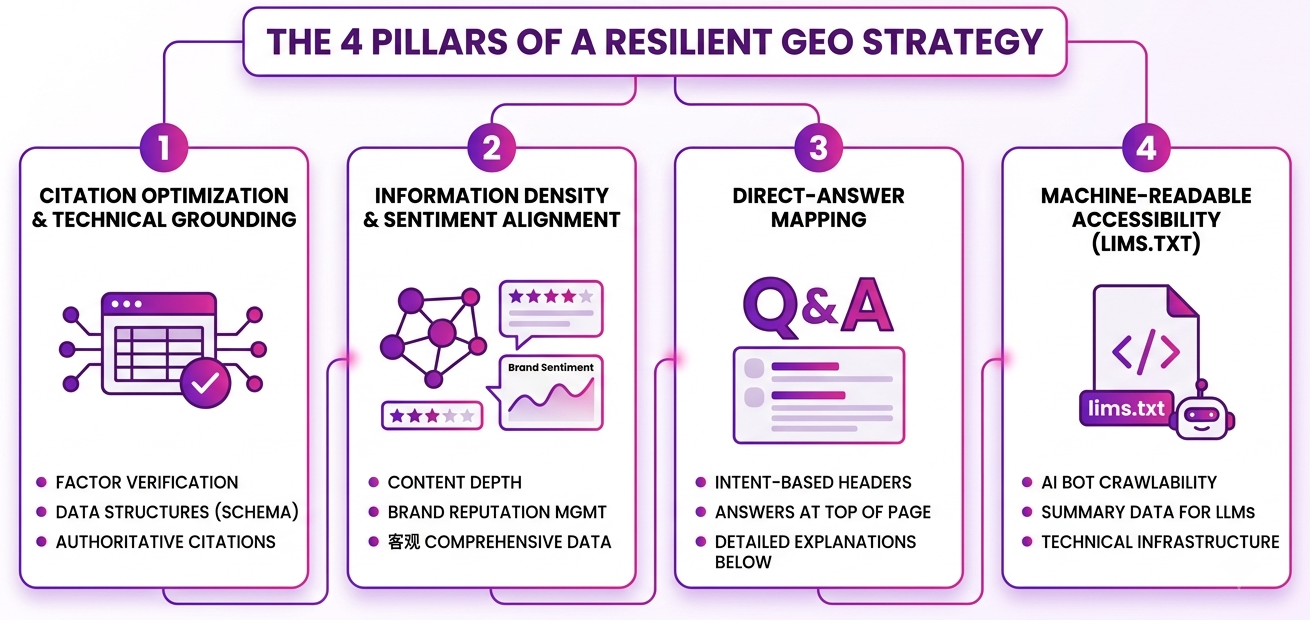
2. Information Density and Sentiment Alignment
Generative models do not look at your website in a vacuum. They cross-reference your site with independent reviews, platform discussions, and industry papers. GEO requires managing your broader digital ecosystem. Positive brand mentions, objective product comparisons, and un-gated technical documentation across third-party networks provide the corroborating cross-references that LLMs look for when validating a brand’s authority.
3. Direct-Answer Mapping
Buyers use generative search for speed. Your informational content should mirror this intent by placing explicit, direct answers at the absolute top of your technical guides, followed by deep architectural breakdowns. This allows LLM retrieval mechanisms to easily grab the high-level response for its direct answer block while pulling from the lower sections for deep-dive citations.
4. Machine-Readable Accessibility (lims.txt)
Just as robots.txt dictated which paths traditional search bots could crawl, emerging standards like lims.txt govern how artificial intelligence engines consume, summarize, and utilize your brand’s data. Understanding how these platforms evaluate AI-generated content and where you get cited is a critical prerequisite when configuring your corporate technical architecture to support or block algorithmic scrapers.
Industry-Wise GEO Queries: How AI Platforms Process and Cite
When users search AI platforms, they rarely use simple fragments like “B2B SaaS software.” Instead, they enter highly nuanced, multi-layered scenarios.
The table below breaks down how different industries must adapt their content strategy to match how AI platforms parse and serve information.
| Industry | Typical High-Intent AI Prompt | What the AI Looks For (Retrieval Signal) | How to Format Your Content to Get Cited |
| B2B SaaS & Tech | “Compare the security features, API integration limits, and pricing of HubSpot vs Salesforce for a mid-market manufacturing company.” | Clear parameter matrices, transparent pricing data, and developer documentation schemas. | Use a detailed Markdown table comparing competitors across explicit features. Avoid vague marketing fluff. |
| Healthcare & Medical | “What are the clinical differences between lipolysis and coolsculpting regarding recovery time and patient eligibility?” | Medical consensus, peer-reviewed data, strict definition compliance, and high E-E-A-T author credentials. | Lead with clear, inline definitions for medical terms. Cite clinical trials with exact numbers and clear bullet points. |
| Finance & Fintech | “Explain the tax implications of utilizing a backdoor Roth IRA if my modified adjusted gross income is over $160,000.” | Definitive legal/financial thresholds, updated tax brackets, and structural logic. | Use Bold headers separating criteria conditions. Include a worked calculation example with exact calculations. |
| E-Commerce & Retail | “Find me highly-rated, waterproof hiking boots for wide feet under $150 that are available to ship immediately.” | Product schema markup, real user review sentiment analysis, real-time pricing, and inventory depth. | Implement pristine Product and Review Schema. Structure product specifications clearly in bulleted lists. |
| Local Services & Hospitality | “I need a commercial plumber in Austin that handles emergency grease trap cleanouts and offers 24/7 service.” | Geo-coordinates, service radius clarity, explicit hours of operation, and localized landing pages. | Optimize your Google Business Profile meticulously. Create dedicated landing pages detailing localized service offerings. |
Autonomous Workflows: Where GEO Meets the AI Ecosystem
An effective presence within generative engines is only the beginning. The ultimate end-state of corporate discovery in 2026 is ensuring your business is recommended when autonomous systems search for answers on behalf of human operators.
As enterprise teams increasingly rely on multi-agent frameworks to optimize internal operations, these agents rely on the same generative search protocols to build toolkits, source vendors, and evaluate B2B technology stacks. Ensuring your brand’s digital footprints are optimized for GEO guarantees your content acts as a key reference point when autonomous platforms compile vendor lists or analyze market options for corporate buyers.
FAQs: Generative Engine Optimization (GEO)
Q1: What is Generative Engine Optimization (GEO) and how does it differ from traditional SEO?
A: Generative Engine Optimization (GEO) is the process of optimizing web content to ensure it is selected, summarized, and cited by AI engines like ChatGPT, Gemini, and Perplexity. While traditional SEO optimizes for search engine algorithms to rank links on a page, GEO optimizes for LLM synthesis. Traditional SEO prioritizes keyword positioning and backlink volume; GEO prioritizes semantic density, structured entity data, and conversational question-answering formatting.
Q2: How do AI search engines decide which websites to cite in their answers?
A: AI engines use retrieval models to parse the web for contextually rich sources that fill gaps in their baseline knowledge. The selection process favors four specific signals:
- Entity Authority: Clear connections to recognized industry concepts (via Schema markup).
- Information Density: High data-to-word ratios, utilizing original statistics or expert quotes.
- Format Parsability: Clear use of bulleted lists, tables, and Q&A formatting that an LLM can easily ingest.
- EEAT Validation: Clear author credentials and cross-referenced claims that align with known facts.
Q3: Will investing in GEO cause a drop in my traditional organic website traffic?
A: It alters the traffic profile. GEO is designed to capture visibility in “zero-click” search environments, which can result in fewer top-of-funnel informational clicks. However, the traffic that does click through via AI citations carries significantly higher conversion intent. Users who click a source citation within an AI response have already been nurtured by the AI’s summary and are looking for deep execution, making them highly qualified leads.
Q4: Which content formats perform best for getting cited by Large Language Models (LLMs)?
A: LLMs prefer content that requires minimal extraction friction. The highest-performing formats include:
- Direct Q&A Sections: Matching conversational natural language prompts.
- Comparison Tables: Side-by-side data comparing items across two or more attributes.
- Step-by-Step Guides: Sequential workflows where order is critical.
- Statistical Digests: Short paragraphs leading with original research data or specific percentage metrics.
Q5: How does schema markup impact a website’s visibility in AI Overviews?
A: Schema markup acts as a direct data map for AI crawlers. By explicitly defining entities, relationships, products, and authors using JSON-LD schema, you bypass the AI’s need to “guess” your context. This structured data makes your content highly retrievable for specific algorithmic modules, such as Google AI Overviews’ product grids or local map stacks.
Q6: Can small or new websites compete with giant brands in GEO?
A: Yes. GEO levels the playing field because AI engines value hyper-specific, contextually perfect answers over raw domain authority. If a niche website provides a precise, data-backed answer to a highly complex, multi-variable prompt (e.g., “best accounting software for remote medical clinics under 10 employees”), an LLM will frequently cite that specific source over a generic guide from a massive aggregator.
Q7: What are the main differences between optimizing for Gemini vs. Perplexity?
A: While both rely on real-time web retrieval, their ecosystems dictate different optimization approaches:
- Google Gemini: Heavily integrated with the Google Knowledge Graph and Google Maps. It prioritizes sites optimized for Google’s traditional core systems, YouTube content, and structured local data.
- Perplexity: Operates purely as an answer engine. It relies intensely on real-time web indexes and displays a strong preference for highly authoritative, technical text, academic papers, and detailed journalistic tables.
Q8: How often should content be updated to maintain its AI citation status?
A: Evergreen informational content should be audited and refreshed annually. However, pages dealing with volatile data—such as “top software,” “pricing models,” or “industry statistics”—should be updated quarterly. AI engines actively look at temporal tags and web freshness markers; if your content contains outdated years or stale statistics, the engine will drop it in favor of a newer index.
Q9: How can I track my website’s performance and rankings in AI search engines?
A: Because traditional keyword ranking tools cannot track dynamic, personalized AI chats, tracking GEO relies on alternative indicators:
- Impression-to-Click Divergence: Monitoring Google Search Console for pages with surging impressions but flat CTR, indicating your content is powering an AI Overview snippet.
- Brand Mention Audits: Running periodic manual incognito prompts across ChatGPT, Gemini, and Perplexity for your core target queries to audit visual citations.
- Referral Traffic Logs: Tracking traffic spikes from specific user-agents like OAI-SearchBot or Perplexity referral links.
Q10: Does using AI-generated content on my own blog hurt my chances of being cited by other AI platforms?
A: Not inherently, but it increases the risk of exclusion. If your blog publishes generic, surface-level AI text, it will lack the unique insights, original data, and structural variance that RAG algorithms search for. AI engines look for novel text segments to synthesize. If your content sounds exactly like the LLM’s own training data, it has zero incentive to pull and cite your URL.