

Most B2B startups do not fail because they built the wrong product. They fail because the right buyers never found them. Building a digital marketing strategy for B2B startups in 2026 is not about doing everything — it is about doing the right three or four things with enough focus and consistency to build compounding pipeline before the runway runs out. The same shift toward agentic AI for business that is reshaping how companies operate is also reshaping how buyers find vendors and the startups winning pipeline in 2026 are the ones that have adapted their marketing to both realities simultaneously.
This guide covers the channels, tactics, and frameworks that are actually generating pipeline for B2B startups right now — with the data behind each one and the honest trade-offs every founder needs to understand before allocating budget.
The B2B Startup Marketing Reality in 2026
Before building any strategy, there are three facts about the current B2B buying environment that change how you should allocate every marketing rupee or dollar.
89% of B2B buyers research products online before making a purchase decision. 60% rely on digital content to make their final decision. This means your content is doing sales work whether you have a sales team or not. Every founder who says “we grow through referrals and relationships” is correct — and their referral partners are being Google-searched, ChatGPT-queried, and LinkedIn-scrutinised before the referred prospect ever picks up the phone.
The average B2B buyer journey now lasts 272 days, involves 88 touchpoints, four channels, and ten stakeholders. For a startup with a six-person team and limited runway, this is the most important stat in B2B marketing right now. You cannot outspend your way to 88 touchpoints. You have to build a system that creates them at low marginal cost — which is exactly what a well-structured digital marketing strategy does.
When an AI summary appears in Google results, users click traditional links only 8% of the time, versus 15% without AI summaries. The implication: organic search traffic is declining for the same pages that would have received it a year ago. The startups that understand this are building visibility in AI-generated answers — not just Google’s ten blue links.
These three facts define the strategic frame. Everything that follows is built inside it.
The 5 Channels That Actually Work for B2B Startups in 2026
Not all marketing channels are equal for a startup. The right channels depend on your ICP, your sales cycle, and your available capacity. Here is an honest assessment of what is working, for whom, and what it costs in time and money.
1. LinkedIn — The Highest-ROI Channel for B2B Decision-Maker Reach
75% of B2B buyers use social media in their purchase decisions — and LinkedIn accounts for the dominant share of that influence for professional and enterprise buyers.
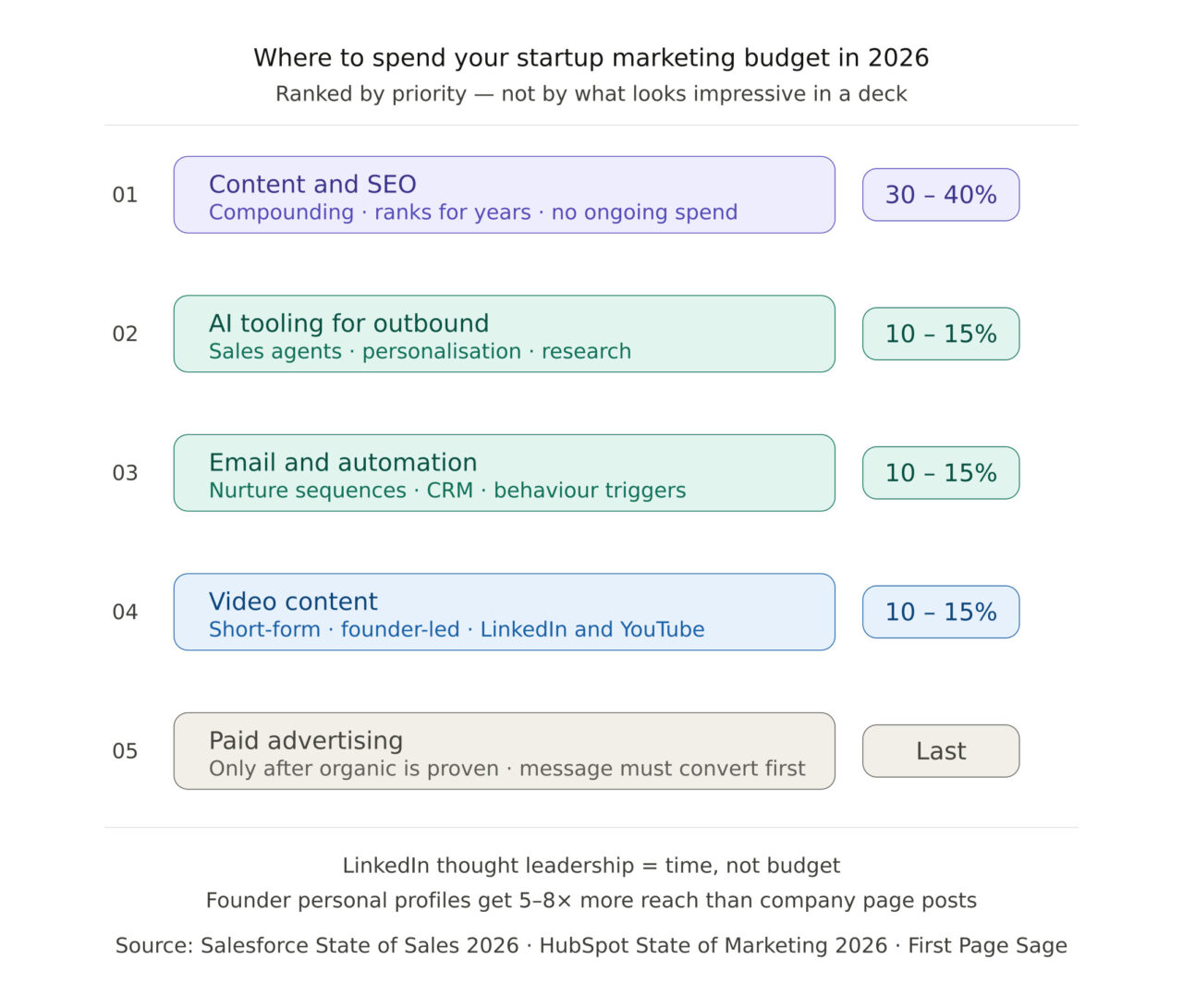
For B2B startups, LinkedIn works on two levels. The company page builds brand awareness and distributes content at scale. Personal profiles — founder, CMO, head of sales — generate five to eight times more organic reach than company page posts and build the individual trust that precedes commercial conversations.
The practical framework: post three times per week across the founding team’s personal profiles. One post per week from the company page. Every post ends with a question to drive comments. Every blog goes in the first comment — never the caption body. The algorithm suppresses posts with external links in the body. This is not optional.
The top B2B marketing channels in 2026 include in-person events at 60%, video at 59%, and thought leadership content at 57% — LinkedIn is the primary platform where thought leadership distributes.
The honest caveat: LinkedIn content marketing takes three to six months to compound. It is not a quick pipeline tool. It is a long-term trust-building system that makes every other marketing channel more effective.
2. SEO and Content Marketing — The Compounding Asset
65% of B2B brands do not handle content marketing entirely in-house — they get help with keyword research, content writing, and distribution. This is not because content marketing does not work. It is because doing it well requires consistent output over time — which is difficult for a startup team managing product, sales, and operations simultaneously.
The B2B startup content strategy that works in 2026 has two layers. The first is pillar content — comprehensive, data-rich, authoritative guides on the core topics your ICP searches for when they have the problem you solve. These rank on Google, appear in AI-generated answers, and generate inbound enquiries for months after publication. The second is cluster content — shorter, more specific posts that support the pillars and capture long-tail searches.
B2B companies using strategic keyword research achieve 702 to 1,389% ROI from SEO according to First Page Sage research. That range is wide because execution quality varies enormously. The high end comes from content that is genuinely authoritative, properly structured, and built around real search intent — not content produced purely for volume.
One critical change for 2026: SEO content must also be optimised for AI-generated answers, not just Google’s traditional rankings. Generative Engine Optimization is the discipline that determines whether your content gets cited when a potential buyer asks ChatGPT or Perplexity about the problem you solve. The startups building GEO authority now will be the default citations in 2027.
3. Email Marketing — Still the Highest-Converting Owned Channel
71% of B2B marketers use email newsletters as a core part of their digital marketing strategy. Email has been declared dead every year for a decade and has outlasted every channel that was supposed to replace it.
For a B2B startup, email works differently from how most teams deploy it. The highest-converting B2B email programmes are not broadcast campaigns. They are personalised sequences triggered by specific buyer behaviours — content downloaded, pages visited, demos requested. The email responds to what the buyer just did, not what the marketing calendar says.
HubSpot used ChatGPT to customise emails based on user behaviour and website data — producing an 82% increase in conversions, a 30% improvement in open rates, and 50% more clicks. This is the AI-augmented email approach that is becoming standard in 2026. The infrastructure is accessible to any startup — it does not require an enterprise marketing stack.
4. AI-Augmented Outbound — The Channel Most Startups Are Underusing
95% of B2B marketers now use AI weekly, and 65% use it daily or more — and embedding AI into strategy rather than individual tasks delivers an average of 13% revenue growth and 13% cost savings.
For B2B startups, AI-augmented outbound closes the gap between the outreach capacity a two-person team has and the outreach volume a competitive market demands. A well-deployed AI sales agent handles prospect research, personalised first-touch messages, and follow-up sequences — freeing the founding team for the conversations that actually require their judgment and relationship skills.
The key distinction: AI-augmented outbound is not spray-and-pray at scale. It is high-quality, highly personalised outreach at a volume that a human team cannot produce manually. The difference in response rates — 15 to 25% for AI-personalised sequences versus 3 to 5% for generic outreach — is the difference between a pipeline and a noise problem.
5. Video — The Fastest-Growing B2B Marketing Channel
Short-form video is the most leveraged media format by marketers and delivers the highest reported ROI — with 73% of consumers preferring short-form video to learn about a product or service.
For B2B startups, video does not mean production budgets and studio shoots. It means founder-led short-form content on LinkedIn and YouTube — screen recordings explaining a concept, a 60-second breakdown of a stat that matters to your ICP, a 90-second demo of a product capability.
92% of businesses consider video one of the most important parts of their digital strategy in 2026. The cost of entry is a smartphone and a quiet room. The compound value — content that stays discoverable, shareable, and repurposable across platforms — makes it one of the highest-leverage activities a founding team can invest time in.
The Framework: How to Prioritise When You Cannot Do Everything
Every B2B startup faces the same constraint: limited time, limited budget, unlimited things you could theoretically do. The framework below cuts through that.
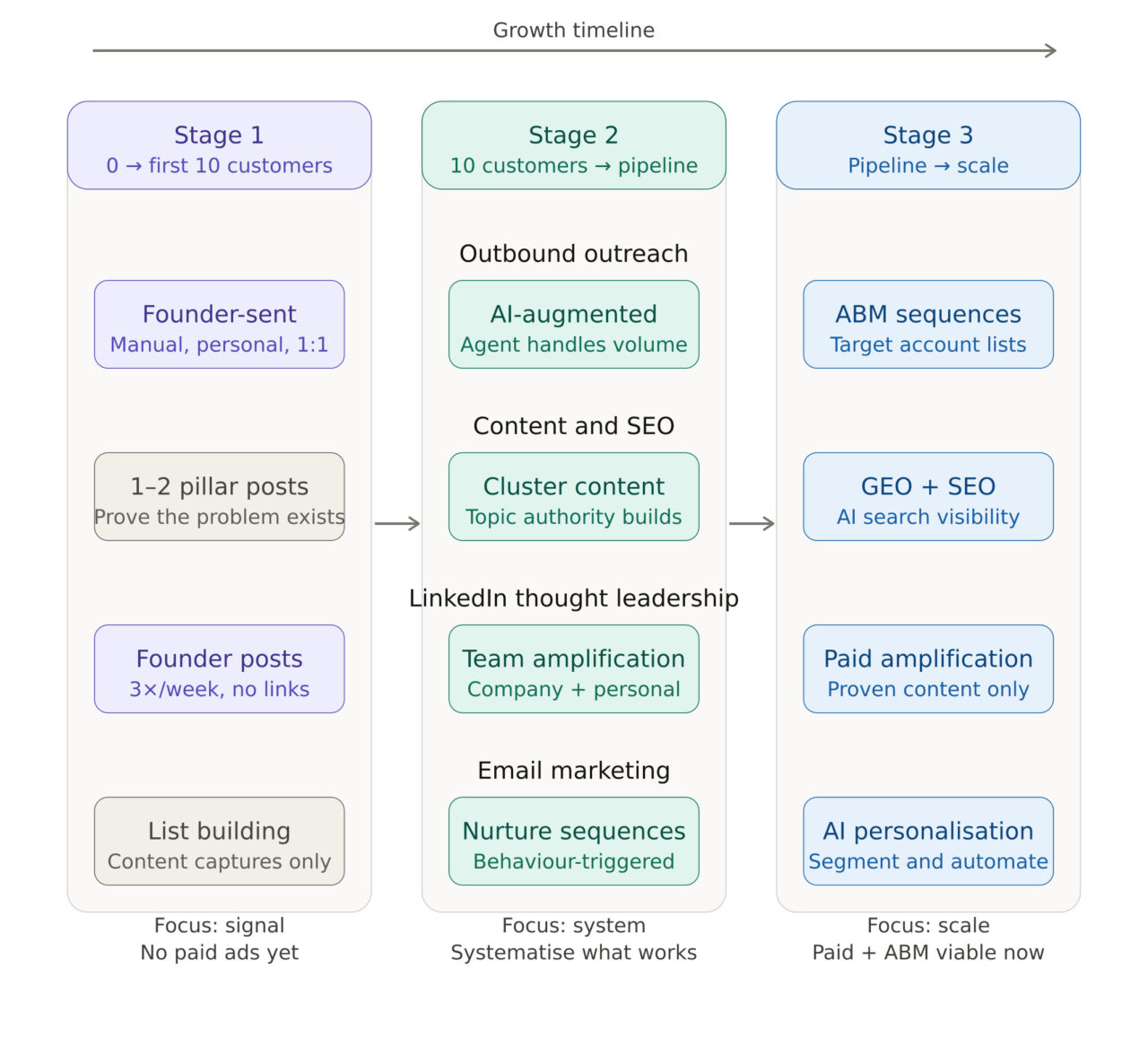
Stage 1 — Zero to first 10 customers (months 0–6)
At this stage, the goal is not scale — it is signal. What message lands? What ICP converts? What channel produces the fastest feedback loop? The answer is almost always direct outbound — personalised, research-backed, founder-sent — combined with two or three pieces of high-quality content that rank for the primary problem your ICP searches for. Do not invest in paid ads at this stage. You do not yet know enough about your buyer to spend money on reach.
Stage 2 — 10 customers to repeatable pipeline (months 6–18)
Once you have signal, you build the engine. This is when content marketing, LinkedIn thought leadership, and email nurture sequences start. The ICP is defined. The message is proven. The goal is to systematise what is working and reduce the founder’s time-per-lead. This is also when AI-augmented outbound replaces manual prospecting.
Stage 3 — Repeatable pipeline to scale (months 18+)
At this stage, paid LinkedIn campaigns and SEO become the primary investment areas because you have enough data to spend efficiently. Account-based marketing becomes viable because you have a defined list of target accounts and proven content to serve them. ABM-led programmes generate 2.6 times more pipeline per marketing dollar than broad-reach demand generation, per ABM Leadership Alliance and Demandbase 2026 data.
The One Thing Most B2B Startups Get Wrong
Most B2B digital marketing programmes fall short not because the strategies are wrong but because those strategies operate in silos. When each channel runs independently, the overall strategy loses momentum and impact.
A LinkedIn post that links to a blog that captures an email that triggers a sequence that leads to a demo — this is a system. A LinkedIn post that goes nowhere, a blog that has no email capture, and an outbound sequence that references nothing the buyer has already seen — this is activity without architecture.
The startups generating the strongest pipeline in 2026 are not running more channels. They are running fewer channels that are tightly integrated — each one feeding the next stage of the buyer journey.
Your first-party data strategy is the connective tissue between channels. Without it, you cannot track what is working, personalise what comes next, or understand which content is actually moving buyers toward a decision. Every piece of first-party data — an email subscription, a content download, a demo request — is a signal about buyer intent that every other channel can use.
What B2B Startup Marketing Budgets Actually Look Like in 2026
B2B organisations spend an average of 8.7% of their total budget on marketing. For an early-stage startup, this benchmark is less relevant than a practical allocation framework.
The most effective B2B startup marketing budgets in 2026 split roughly as follows. Content creation and SEO takes 30 to 40% — this is the compounding asset that pays returns for years. LinkedIn thought leadership and personal brand takes 20 to 25% of time investment, minimal direct cost. AI tooling for outbound and content takes 10 to 15% of budget — affordable and high-leverage. Email infrastructure and automation takes 10 to 15%. Video production takes 10 to 15%. Paid advertising is last — only after the organic foundation is built and you have data on what converts.
Enterprise marketing budgets remain flat at 7.7% of company revenue, and 59% of CMOs say their budget is insufficient. This is true at enterprise. At startup scale, the constraint is almost never budget — it is focus. The startup that does three channels excellently will always outperform the one that does eight channels adequately.
FAQs:
How long does it take to see results from B2B digital marketing?
It depends on the channel. AI-augmented outbound produces pipeline within 30 to 60 days of a properly scoped deployment. Email marketing generates measurable response improvements within the first campaign cycle. Content marketing and SEO take three to six months to begin compounding — but the returns are long-term and do not require ongoing spend to maintain. LinkedIn thought leadership builds audience and inbound enquiries over six to twelve months. The mistake most startups make is expecting every channel to produce leads in the first 30 days and abandoning the ones that take longer before they have had time to work.
What is the most cost-effective digital marketing channel for a B2B startup?
LinkedIn personal profile content — founder-led thought leadership — delivers the highest reach-to-cost ratio of any channel available to a B2B startup in 2026. It costs time, not money, and produces five to eight times more organic reach than company page content. Combined with a focused content marketing strategy that produces one or two high-quality pillar pieces per month, this is the foundation that every other channel amplifies.
Should a B2B startup invest in paid advertising?
Not before establishing organic foundations. Paid advertising amplifies what is already working — it does not create signal from scratch. A startup that runs paid LinkedIn campaigns without a clear ICP, proven message, and content to send traffic to will burn budget generating impressions that produce no pipeline. The right sequence is organic first, paid after you have data that tells you what to amplify.
How important is content marketing for B2B startups?
91% of B2B marketers now use content marketing as part of their strategy. It is not optional — it is infrastructure. In a world where buyers complete 60 to 70% of their research before ever speaking to a sales rep, content is the salesperson working 24 hours a day on every channel simultaneously. The question is not whether to invest in content marketing — it is whether to produce content that is genuinely authoritative and differentiated, or content that adds to the noise.
How does AI change digital marketing for B2B startups in 2026?
AI changes digital marketing for B2B startups in three specific ways. It makes personalised outreach at scale feasible for small teams. It enables content production that is faster without sacrificing quality, when used correctly. And it changes where buyers discover vendors — shifting influence from traditional search rankings to AI-generated answers. The startups adapting to all three simultaneously are the ones compounding the fastest.
Ready to build a digital marketing engine for your B2B startup?
Cosnet’s digital marketing team works with B2B startups across India, USA, UK, and the UAE — building content strategies, GEO foundations, and AI-augmented marketing systems that generate pipeline from month one.
Talk to our team about your digital marketing services — from strategy to execution.