Why Connected Healthcare Workflows Make Platforms Scale
India's eSanjeevani puts a fine point on this. The platform's own framing of its work is disarmingly simple: "a connected experience, not a collection of isolated features." It's a stronger claim than it sounds. Most digital health vendors sell on feature count — more specialties, more integrations, more channels. eSanjeevani's national numbers argue for the opposite thesis: architecture that connects appointments, consultations, records, and prescriptions into one dependable workflow is what actually lets a platform absorb national-scale demand — over 200 million teleconsultations, 110,000+ patients served daily, and a footprint spanning 1,000+ locations, per the platform's engagement data. For context on trajectory, India's Ministry of Health has separately reported eSanjeevani crossing 43 crore (430 million) cumulative teleconsultations nationally as of November 2025, underscoring how far the underlying architecture has had to scale since launch.
The Feature Trap: Why More Capabilities Don't Equal More Scale
Enterprise health platforms tend to fail at scale for a predictable reason: teams solve accessibility, records, and consultation delivery as separate problems, each with its own vendor, data model, and release cycle. The result is a system that looks complete on a feature matrix and falls apart the moment a real patient journey crosses module boundaries — booking an appointment on a mobile browser, consulting via a low-bandwidth video call, and expecting a prescription to land in a record a pharmacy or follow-up provider can actually read.
This is architectural risk, not a UX nitpick. Every unconnected module is a point where state can desync, where authentication has to be re-solved, where a patient's context gets lost and has to be re-entered. At national scale — hundreds of locations, mixed connectivity, mixed digital literacy — that desync compounds into abandoned consultations, duplicate records, and support load that no amount of additional "features" fixes. The fix is structural: treat the patient journey as one workflow with one source of truth, not a chain of handoffs between systems that were never designed to talk to each other. That's precisely the failure mode connected healthcare workflows are engineered to eliminate.
What "Connected" Actually Means at the Architecture Level
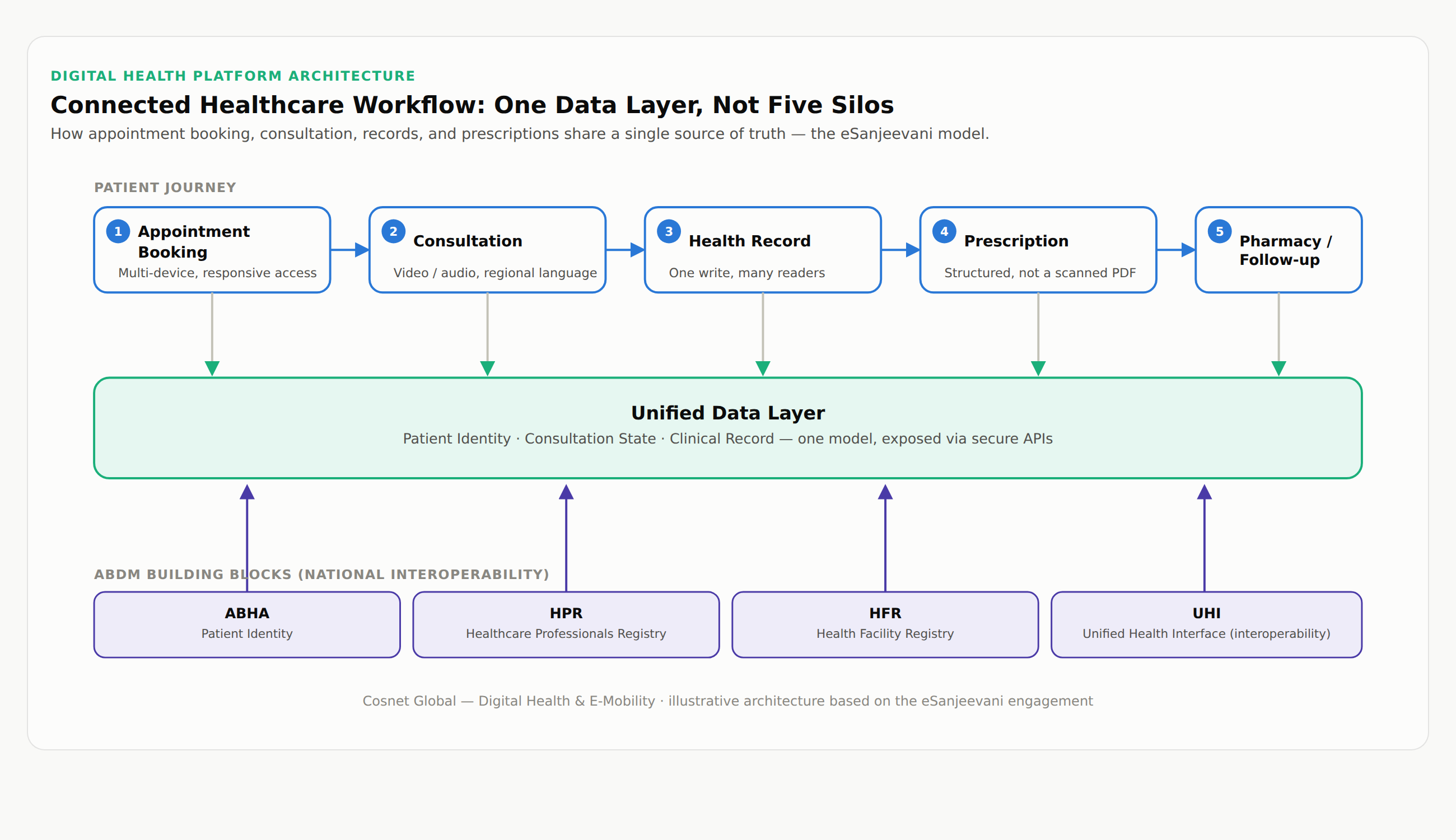
Connected healthcare workflows aren't a marketing concept — they're a specific architectural commitment: appointment scheduling, consultation delivery, the health record, and the prescription all read and write against a shared, authoritative data layer, exposed through secure APIs rather than point-to-point integrations bolted on after the fact.
In practice this means an API gateway and service layer where consultation state, patient identity, and clinical documentation are modeled once and referenced everywhere — not duplicated per module. It means the booking flow and the consultation flow share session and identity context so a patient isn't re-authenticating or re-entering history mid-journey. And it means the prescription generated at the end of a consultation is written directly into the same record structure the next provider will query, rather than exported as a PDF that lives nowhere searchable. This is the difference between a platform with a lot of screens and a platform with a workflow — and it's the difference that determines whether a system can hold up at 110,000 patients a day or buckle at a fraction of that.
Inside eSanjeevani: A Connected Workflow at National Scale
Cosnet's own eSanjeevani case study illustrates what connected healthcare workflows look like when they're built deliberately rather than assembled reactively. The work spans UX/UI design for simplified consultation journeys, web and application development for multi-device responsive access, secure APIs connecting appointments to records to prescriptions, and scalable backend services purpose-built for healthcare workflows rather than adapted from generic SaaS patterns.
The results are the proof point: 200M+ teleconsultations delivered, 110,000+ patients served daily, and representation across 1,000+ locations — figures that only hold up if the underlying workflow doesn't degrade as concurrent load and device diversity increase. eSanjeevani's national rollout originally launched as a doctor-to-doctor, hub-and-spoke teleconsultation model before expanding to direct patient-to-provider access, and it now runs across all 28 states and 8 union territories — a footprint that makes "collection of isolated features" a structurally untenable approach, and "connected experience" closer to an engineering requirement than a slogan.
Interoperability as Infrastructure, Not an Afterthought
For an enterprise health platform operating in India, interoperability isn't optional polish — it's what the national digital health stack expects. The Ayushman Bharat Digital Mission (ABDM) defines the building blocks a connected platform needs to plug into: the ABHA health ID for patient identity, the Healthcare Professionals Registry (HPR) and Health Facility Registry (HFR) for provider and facility identity, and the Unified Health Interface (UHI) as the open-protocol layer that lets previously siloed systems exchange data. A platform architected around connected healthcare workflows internally is far better positioned to expose FHIR-aligned, ABDM-compatible interfaces externally, because the internal data model is already unified rather than fragmented across modules.
This same discipline — treating data as a connected asset rather than a per-feature silo — is what separates platforms that can support predictive, longitudinal use cases (tracking a patient's journey across consultations over time, or feeding aggregate trends back into operational planning) from those that can only report on isolated transactions. It's the same principle Cosnet has applied in pharma data analytics work, and the broader discipline is covered in more depth in data science and analytics for businesses — in both cases, the value only materializes once the underlying data is connected end-to-end, not fragmented across systems that were never meant to be queried together.
Compliance by Design: DPDP, Telemedicine Guidelines, and Cross-Border Data
Connected workflows raise the compliance stakes, because a unified patient record is a larger, more consequential asset than a dozen disconnected ones — which makes compliance-by-design a structural requirement, not a policy afterthought.
Two frameworks matter most for a platform operating in India. The Telemedicine Practice Guidelines, 2020 (issued jointly by the Medical Council of India / Board of Governors and the Government of India) set the operating rules for how registered medical practitioners can conduct teleconsultations — covering consent, the modes of communication permitted, and prescription rules that any connected consultation-to-prescription workflow has to encode directly into its logic, not bolt on as a manual check. Second, the Digital Personal Data Protection Act, 2023 (DPDP Act) — India's cross-sector data protection law, with the Data Protection Board provisions brought into force in November 2025 — governs how personal data, including the health data flowing through a connected workflow, must be consented to, processed, and protected, with penalties for serious violations (such as failing to implement reasonable security safeguards) reaching up to ₹250 crore. For platforms with any cross-border footprint or enterprise clients in the US, EU, or UK, this sits alongside — not instead of — frameworks like HIPAA, GDPR/UK GDPR, and security postures such as SOC 2 or ISO 27001, which enterprise buyers increasingly expect as baseline proof of operational maturity.
Designing for Rural Reach and Variable Connectivity
A connected workflow only delivers value if patients can actually complete it — and for a platform reaching 1,000+ locations across India, that means designing for the low-bandwidth, mixed-device, mixed-literacy reality of rural and semi-urban access, not the reliable broadband and high-end devices most platforms are designed and tested against by default.
This shows up as concrete architectural choices: responsive interfaces that perform on low-end Android devices and degrade gracefully on unstable connections, rather than assuming a desktop-class experience; regional-language accessibility built into the consultation and records interface rather than retrofitted as a translation layer; and fallback paths — such as routing patients without personal devices through a nearby facility for an assisted consultation — engineered as first-class workflow states, not edge cases. None of this is solvable by adding more features. It's solvable by making the core workflow resilient enough that accessibility constraints don't fracture the patient journey into a degraded, disconnected experience for the users who need it most.
Governance at Scale: Where Connected Workflows Break Down
As digital health platforms mature, many are layering in AI-driven triage, documentation assistance, or orchestration agents on top of the consultation workflow — and this is exactly where a connected architecture either pays off or turns into a liability. An AI agent operating against a unified, well-governed data layer can meaningfully assist a consultation. The same agent operating against fragmented, ungoverned data sources becomes a new integration risk and a new compliance exposure, especially in a healthcare context where the underlying data is sensitive personal information.
This is the same governance discipline covered in Cosnet's work on AI agent governance: every automated or agentic component touching a connected healthcare workflow needs the same identity, access, and audit rigor as the human-facing parts of the system — not a lighter-touch exception because it's "just automation." Platforms that get this right treat AI orchestration as another connected layer subject to the same architectural and compliance standards as the rest of the workflow; platforms that don't create exactly the kind of fragmentation the connected-workflow model was built to eliminate.
The Business Case: What Connected Workflows Return
For the operational and executive side of the business, the case for connected healthcare workflows isn't abstract engineering elegance — it shows up directly in throughput and cost. A platform that can reliably move a patient from booking through consultation to a usable prescription record, without manual reconciliation or duplicate data entry, is a platform that can absorb demand growth (110,000+ patients a day, in eSanjeevani's case) without a proportional increase in support and operations headcount. It's also a platform that can add a new location, language, or care pathway faster, because new capability plugs into an existing connected data model instead of requiring a new integration project each time. Integration debt — the accumulated cost of stitching together systems that were never designed to connect — is one of the largest hidden drags on time-to-market for enterprise health platforms, and it's precisely what a connected-workflow architecture is designed to avoid accruing in the first place.
A Phased Approach: Discovery, Pilot, Scale
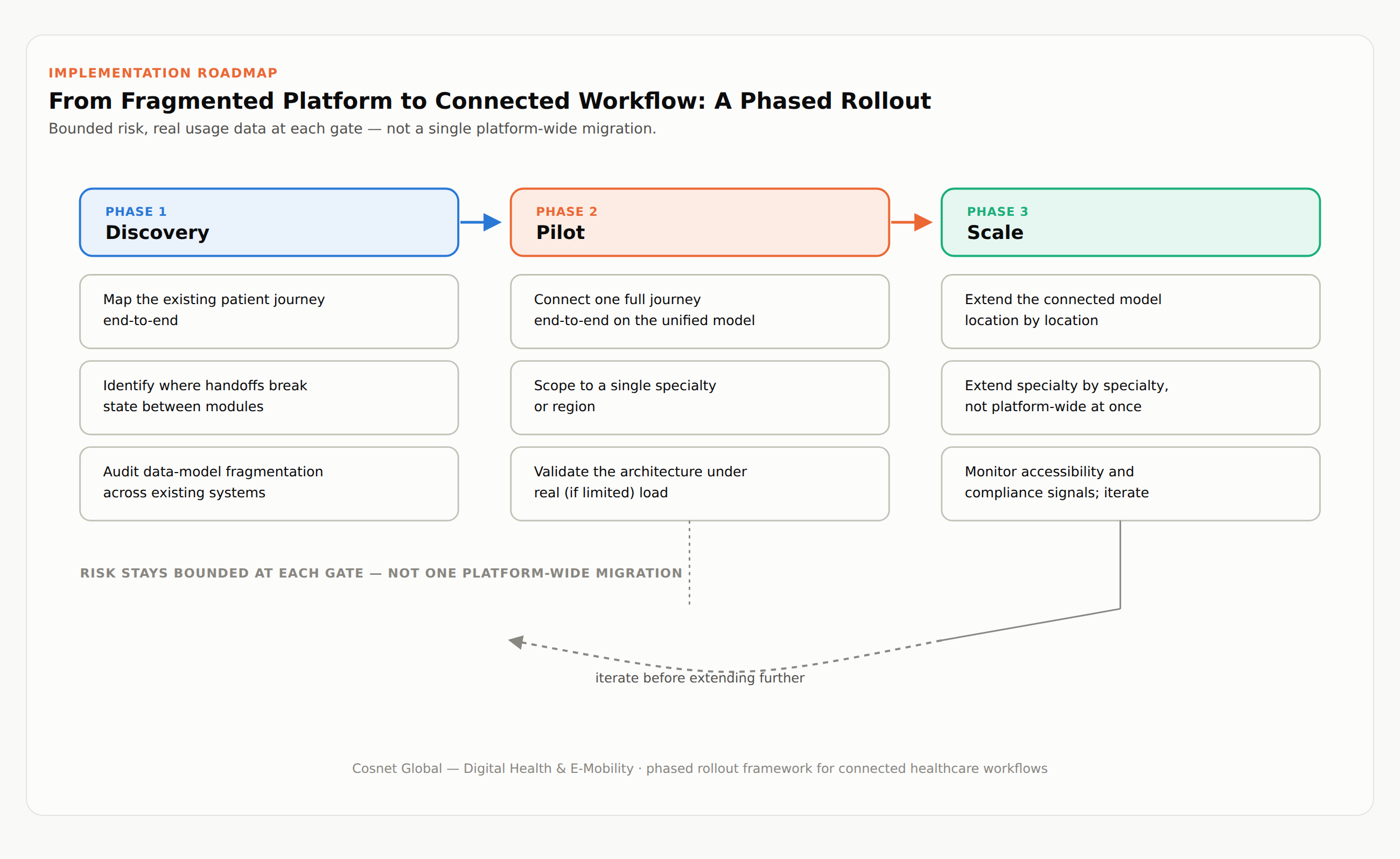
Getting from a feature-fragmented platform to one built around connected healthcare workflows is rarely a rip-and-replace project, and shouldn't be pitched as one to an executive stakeholder weighing risk against time-to-market. A discovery phase should map the current patient journey end-to-end, identifying exactly where handoffs between booking, consultation, records, and prescriptions currently break state or require manual reconciliation. A pilot should connect one complete journey — often appointment-to-prescription for a single specialty or region — end-to-end on the unified data model, proving the architecture under real (if limited) load before committing to a full migration. Scale-out then extends the same connected model location by location and specialty by specialty, rather than platform-wide in one release, which keeps risk bounded and gives the organization real usage data to validate accessibility and compliance decisions before they're locked in at national scale.
FAQ's
1. What does "connected workflow" mean in digital health platform architecture?
A connected healthcare workflow means appointment scheduling, consultation delivery, health records, and prescriptions all read and write against one shared, authoritative data layer gethrough secure APIs — rather than existing as separate modules that pass data between each other manually or not at all.
2. Why do digital health platforms struggle to scale even with strong feature sets?
Feature-rich platforms often struggle because each feature was built and integrated independently, so patient context, identity, and clinical data fragment across systems — every handoff between modules becomes a point where state can desync or data gets lost as usage grows.
3. How did eSanjeevani achieve over 200 million teleconsultations?
eSanjeevani's architecture connects UX/UI design, multi-device web and application access, secure APIs, and scalable backend services into a single consultation-to-prescription workflow, which is what allowed it to absorb growth to over 200 million teleconsultations and 110,000+ patients served daily without the workflow breaking down.
4. What is ABDM and how does it relate to platform interoperability?
The Ayushman Bharat Digital Mission (ABDM) is India's national digital health infrastructure, built around the ABHA health ID, the Healthcare Professionals Registry (HPR), the Health Facility Registry (HFR), and the Unified Health Interface (UHI) — a connected-workflow platform is far better positioned to integrate with these building blocks than a fragmented one.
5. Is eSanjeevani compliant with India's telemedicine regulations?
Consultation workflows on platforms like eSanjeevani are designed to operate within the Telemedicine Practice Guidelines, 2020, which govern how registered medical practitioners can conduct teleconsultations, including consent, permitted communication modes, and prescription rules.
6. How does the Digital Personal Data Protection Act (DPDP) 2023 affect digital health platforms in India?
The DPDP Act governs how personal data, including health data, must be consented to, processed, and protected across any digital platform operating in India, with penalties for serious violations — such as inadequate security safeguards — reaching up to ₹250 crore, making compliance-by-design a structural requirement for any connected health workflow.
7. What's the difference between an EHR integration and a truly connected healthcare workflow?
An EHR integration typically means a health record system exchanges data with other systems after the fact, often via batch exports or point-to-point connectors; a connected workflow means the record is written to and read from as part of the same real-time data model the booking and consultation systems use, with no separate reconciliation step.
8. How should a digital health platform handle rural and low-connectivity users?
By designing multi-device, responsive access and regional-language accessibility as core parts of the workflow rather than add-ons — including fallback paths, such as assisted consultations at a nearby facility, engineered as first-class workflow states for users without reliable personal devices or connectivity.
9. Does adding AI agents to a healthcare platform increase compliance risk?
It can, if the AI layer operates against fragmented or ungoverned data sources — AI agents and orchestration layers need the same identity, access, and audit governance as the rest of a connected workflow, not a lighter-touch exception, especially given the sensitivity of health data.
10. How long does it take to move a healthcare platform to a connected-workflow architecture?
Timelines vary by scope, but the recommended approach is phased — a discovery phase to map existing handoff points, a pilot connecting one full patient journey end-to-end, and a scale-out phase extending the model location by location, rather than attempting a single platform-wide migration.
Feature sprawl is easy to sell and easy to demo. A connected healthcare workflow is harder to build and far more defensible at scale — it's the difference between a platform that can plausibly claim 200M+ teleconsultations and one that can't survive its own growth curve. If your platform's roadmap is a list of features rather than a map of one connected patient journey, that's the gap worth closing first. Talk to our Experts.