Digital Marketing with AI That Works: Human-in-the-Loop
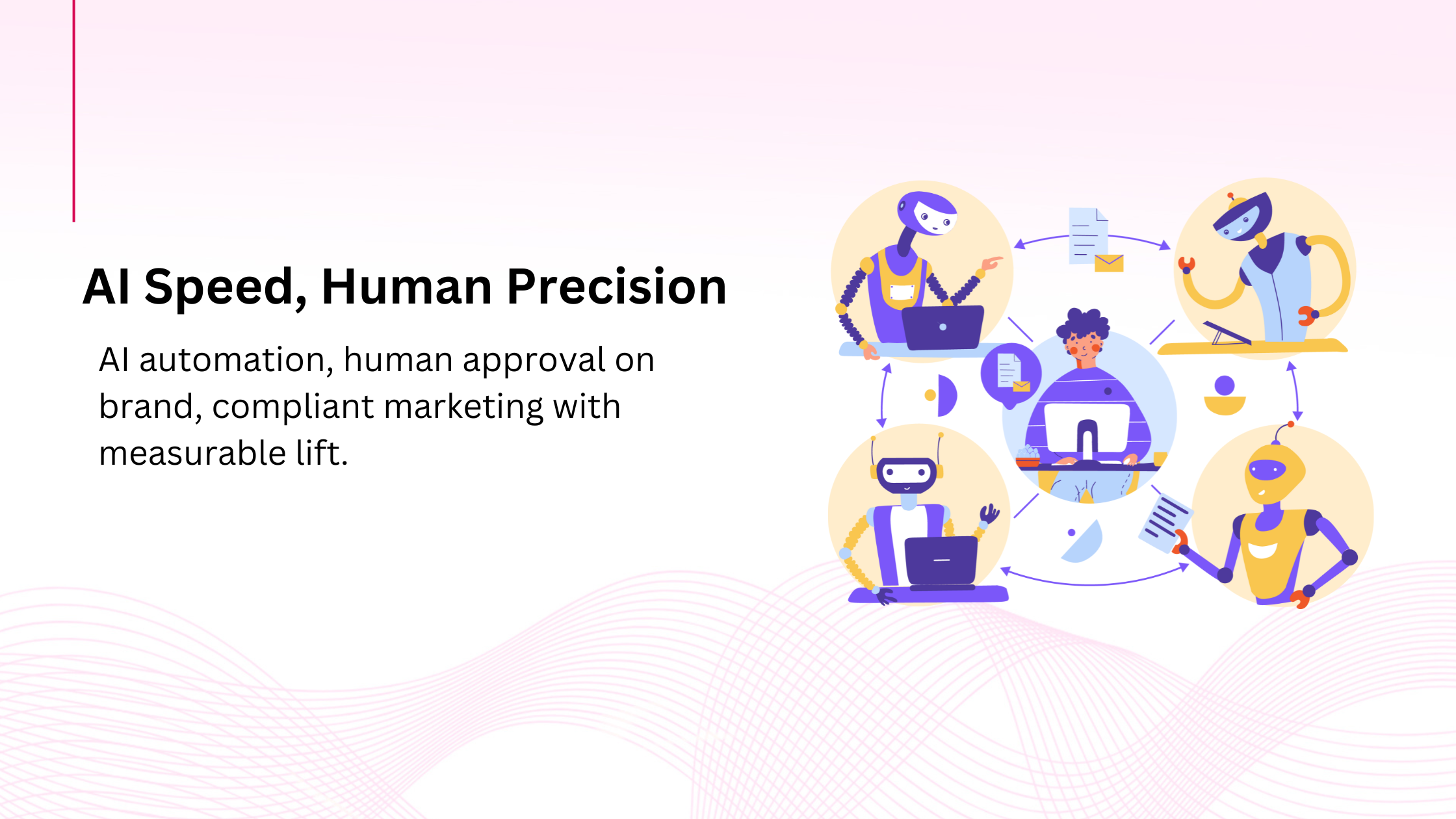
Artificial intelligence (AI) can create copy and visuals at scale, but digital marketing with AI needs a human step to make results reliable. By combining fast generation with simple human checks, your team keeps ads, landing pages, search content, and social posts on-brand, accurate, and ready to convert. If you are shaping the bigger picture, it helps to place this approach inside a broader AI strategy so quality and delivery improve together.
What “human-in-the-loop” means in digital marketing with AI
In plain terms, a person steps in before the AI works (to set the brief), during the process (to review and edit), and after publishing (to learn from results). In real life, your flow looks like this: clear brief → AI drafts → automatic checks (facts, tone, policy, personal data) → human review with a simple checklist → publish and record → learn and improve. Teams usually get better lift when these steps support generative AI in marketing rather than try to replace human judgement.
Where humans add value (the “4 Ds”)
-
Data: choose the key claims, proof points, and tricky edge cases the model often gets wrong.
-
Design: agree success measures, pick tests, and set simple pass/fail rules for each channel.
-
Decision: approve, edit, or escalate anything that feels risky, unclear, or off-brand.
-
Direction: feed lessons back into prompts, writing rules, and campaign playbooks.
A simple workflow for digital marketing with AI (ads, search, social)
-
Brief (human): goal, ideal customer, offer, approved facts, phrases to avoid, brand voice, and risk level.
-
Generate (AI): platform-specific ad copy, angles, hooks, image prompts, outlines, and captions.
-
AI automation checks: match against approved claims, flag banned phrases, check reading ease, remove near-duplicates, and spot platform-policy issues.
-
Human review: use a short checklist; approve, edit, or escalate.
-
Assemble variants: pair the best copy with visuals, make size/aspect-ratio versions, add alt text and subtitles.
-
Launch and log: publish and record what was approved and why.
-
Learn weekly: use winners and losers to improve prompts and rules; for paid media, align tests with the cadence in boost ROI in paid ads so experimentation lowers CPC and CPA without risking quality.
Quick review checklist (keep it next to you)
| Criterion | Minimum bar | Automatic check | What the human checks |
|---|---|---|---|
| Facts | Must be correct | Check against an approved claims list | Every claim is true; no promises you cannot prove |
| Brand voice & clarity | Easy to read; on-brand | Basic readability test | Plain words, clear benefit, strong verbs |
| Policy & platform fit | No violations | Automatic policy check | No risky phrases (e.g., personal attributes on Meta); add disclaimers if needed |
| Differentiation | Not a clone | Similarity check | Fresh angle (pain, proof, payoff) |
| Accessibility | Helpful for all | Alt-text present | Alt-text makes sense; captions work without sound |
Pass rule: Clear score across the list, with no failures on facts or policy.
How the human step improves results (real example)
Raw AI draft: “Our AI guarantees 10× return on ad spend in 7 days.”
After human edits: “Scale creative testing with proven playbooks and rapid AI variants, so you book more demos at a lower cost per acquisition.”
The editor removes the risky guarantee, replaces hype with a clear benefit, and keeps the “testing speed” angle that worked before. It becomes easier to prove the impact when creative changes roll up to business goals, and—as shown in our data science and analytics guide—you track each version against metrics like conversions and cost per acquisition to see what truly performs.
Governance that scales (quality, safety, proof)
This method creates a clear record of who approved what, which facts were used, and what rules were followed. Many teams bake this into their operating model through an AI strategy and sanity-check wording against Google Ads policies during review to avoid disapproval, while an accessibility pass aligned with WCAG guidance ensures alt text and captions meet modern standard
Who does what (plain roles)
-
Growth lead: owns the brief, goals, and final go-live decision.
-
Copy editor: improves clarity and tone; applies the checklist.
-
Compliance reviewer: checks sensitive claims and policy issues.
-
Designer: builds clean, readable creative and variants.
-
Media buyer: launches, tracks results, and labels winners/losers.
-
Data and analytics: connects each asset to results and shares insights.
Simple numbers to track (so you know digital marketing with AI works)
-
Quality: aim for at least 95% of assets to pass on the first try, with two or fewer edits.
-
Speed: aim to go from brief to live in 24 hours for new creatives.
-
Cost: lower the cost per accepted asset by 30–50% in the first month.
-
Performance: lift click-through rate (CTR) by 15–25% from more angles; reduce cost per acquisition (CPA) by 10–20% by month two.
-
Governance: zero policy incidents; every asset has an approval note.
Channel snapshots for digital marketing with AI
Paid ads (Google, Meta, LinkedIn)
Use prompts that fit each platform and an approved claims list. Run the AI automation checks, then a quick human check. You will iterate faster if you follow a testing matrix so you can rotate hooks and calls-to-action safely.
Search content and landing pages
Start from an approved factsheet and outline. Let the tool check readability and links. Editors add story, sources, schema, and in-sentence internal links. For scale, pair planning with generative AI in marketing so volume does not reduce depth, while digital marketing using AI keeps planning, production, and measurement aligned across channels.
Organic social and short video
Draft hooks and captions with simple limits. Run automatic length and rule checks. Editors tune tone, remove hype, and confirm subtitles and alt text before scheduling.
30–60–90 day rollout (keep it light)
Days 1–30 (Pilot)
Pick one campaign and one audience. Set prompts, rules, and the checklist. Log every decision. Ship three waves a week. Do a short daily calibration so editors agree on standards.
Days 31–60 (Scale)
Add a second platform. If a type of asset stays clean for a month, allow a lighter review. Link every asset ID to spend and results so learning is automatic.
Days 61–90 (Improve and govern)
Automate winner analysis directly into your prompts, schedule a quarterly editor calibration, and keep concise approval notes for each asset. If paid media is central to your mix, align these steps with the test matrix outlined in boost ROI in paid ads so experimentation stays fast, compliant, and cost-effective.
FAQs
Is this slower than full automation?
No—automatic checks do most of the work. Humans step in only when risk or confusion is high. Stable items can move to lighter checks.
How do we keep reviewers consistent?
Use one shared checklist, review a small sample together each week, and keep short notes with each asset.
Can AI replace marketers, or is a human step still needed?
AI is excellent at first drafts, variations, and routine checks, but a person still chooses the message, fixes tone, and approves what goes live. That human step is why AI digital marketing stays on-brand and compliant.
How do you measure ROI from digital marketing using AI?
Track first-pass approvals, edits per asset, time from brief to live, click-through rate (CTR), cost per click (CPC), cost per acquisition (CPA), and conversions. Over time you should see faster launch cycles, higher engagement, and lower acquisition costs.
Which channels benefit most when we add AI automation with human review?
Paid ads gain the most from rapid creative testing and safe approvals. Search content and landing pages also benefit because outlines, copy, and variants can be generated quickly, then refined by an editor to protect quality and brand voice.
Notes on abbreviations (for readers)
-
AI: artificial intelligence.
-
CTR: click-through rate.
-
CPC: cost per click.
-
CPA: cost per acquisition.
-
Schema: structured data that helps search engines understand a page.