E-Commerce Systems Integration: What Drives Sales Growth
E-commerce systems integration is usually the real story behind a slow-growth store, even when every complaint points at the site itself: the checkout has too many steps, the mobile experience lags, the design feels dated. So the team redesigns. Traffic ticks up. Conversion barely moves. The actual gap is whether the ERP knows what the storefront knows, whether Amazon and Flipkart see the same stock count as the website, whether a return triggers a refund without someone re-keying it into three separate tools.
E-commerce systems integration is the practice of connecting a storefront to the operational systems behind it — ERP, inventory, marketplace channels, payments, shipping, and returns — so data moves automatically instead of through manual re-entry, because a store that looks fast but runs on disconnected systems will still lose sales to stockouts, pricing errors, and fulfilment delays. This is what actually moves revenue, and it's rarely the first thing a brand fixes.
Why E-Commerce Systems Integration Fails Most Stores
The failure pattern is consistent across categories: a brand invests in UX, sees a traffic bump, and then watches conversion stall because the parts of the business customers never see — inventory accuracy, order routing, channel sync — are still running on spreadsheets, manual CSV exports, or nightly batch jobs.
Inventory Inconsistency Is a Revenue Problem
When stock counts are updated manually or on a delay, two things happen, both expensive. Either the site shows an item as available when it's sold out — the customer orders, the order gets cancelled, refunded, and the trust is gone — or the site shows an item as out of stock when it isn't, and the sale is lost outright before the customer ever reaches checkout. Neither failure is visible in a UX audit. Both show up directly in the sales number.
Multi-Channel Complexity Compounds It
Add a marketplace presence — Amazon, Flipkart, or equivalent regional platforms — and the inventory problem multiplies across every channel independently. A single pool of stock now needs to reflect consistently across the owned storefront and every third-party channel, in something close to real time, or the brand ends up overselling on one channel while underselling on another. [custom software development](https://cosnetglobal.com/blogs/custom-software-development-streamline-business-processes) built around this specific problem — a single source of inventory truth feeding every channel — is what closes the gap; generic plugins rarely hold up once channel count and order volume grow.
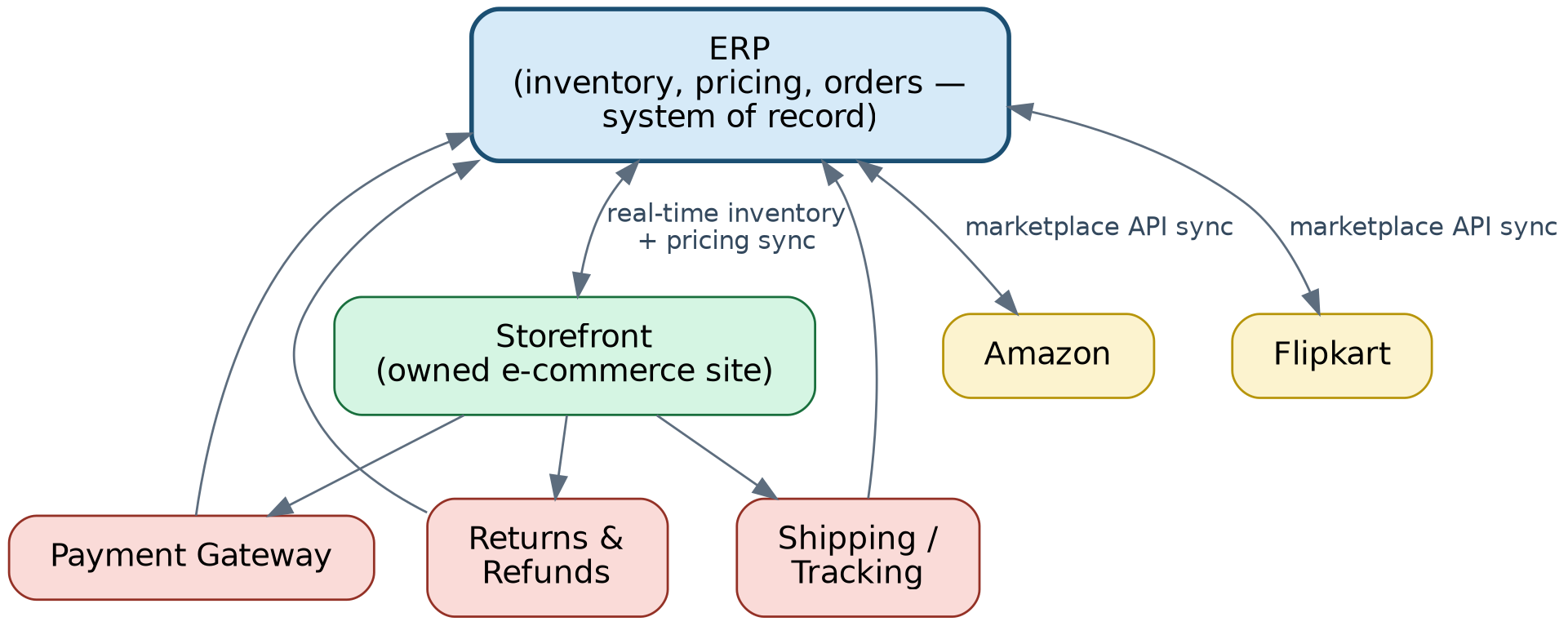
Here's what that connected architecture looks like once ERP, marketplaces, and fulfilment are wired to a single source of truth instead of running as separate silos:
What Actually Moves the Needle
Three integration layers do the actual work that a redesign alone can't.
ERP and Real-Time Inventory Sync
Connecting the storefront directly to the ERP — rather than exporting and re-importing stock files — means every sale, return, and restock updates availability across every channel automatically. This is now treated as baseline infrastructure rather than an advanced feature: stores running frequent sales events or multiple channels are expected to sync in real time or close to it, because the gap between "stock changed" and "storefront reflects it" is exactly where overselling happens. Cosnet's guide to [custom ERP solutions](https://cosnetglobal.com/blogs/boost-efficiency-erp-solutions) covers how this sync layer is typically built and where off-the-shelf connectors stop being enough.
Marketplace API Integration
Catalogue and inventory data connected to marketplace APIs — Amazon, Flipkart, and similar channels — keeps pricing, stock, and product listings consistent without a team manually updating each channel separately. Common ERP-to-storefront pairings reflect this: NetSuite or Odoo alongside Shopify or BigCommerce, SAP Business One, NetSuite, or Odoo alongside Magento or Adobe Commerce. The pairing matters less than the principle — one system of record, every channel reading from it.
Fulfilment and Returns Automation
Payment, shipping, tracking, and returns workflows connected end-to-end remove the manual handoffs that slow fulfilment and create refund errors. A return that starts on the storefront, triggers a credit memo in the ERP, and updates inventory availability automatically is a fundamentally different operation than one that requires a person to reconcile three systems by hand. None of this holds up on a storefront that isn't built for it either — the underlying e-commerce website development has to support real-time state changes at checkout, not just display a static product catalogue.
The order-to-fulfilment path, once every layer is connected, looks like this:

The Skybags Case Study: A Connected Experience, Not a Collection of Isolated Features
Skybags, one of Asia's largest luggage brands, is the clearest proof of what integration — not redesign alone — actually delivers. See the full Skybags case study on Cosnet's portfolio.
The challenge had three parts. The shopping journey itself was outdated, needing a clearer, faster experience across desktop and mobile. Inventory updates were manual, creating gaps between actual stock and what customers saw online. And multi-channel complexity meant products and stock had to stay aligned across the main store, Amazon, and Flipkart simultaneously.
The solution treated the storefront and the operations behind it as one system, not two projects. A responsive commerce UX refreshed discovery, navigation, checkout, and mobile shopping. ERP and inventory sync brought real-time integration that reduced manual availability updates. Marketplace APIs connected catalogue and inventory data to external sales channels. And fulfilment and returns automation tied payment, shipping, tracking, and refund workflows directly into the platform.
The delivery process ran through five phases: a commerce and operations audit, customer journey redesign, integration architecture, storefront and workflow engineering, and testing, rollout, and optimisation — architecture work sitting alongside the design work from the start, not bolted on afterward.
The results: 5M+ pieces sold, 96.9K monthly traffic, and a 25% increase in sales. The brand's own framing captures the mechanism precisely — this was "a connected experience, not a collection of isolated features." The redesign made the storefront faster to use. The integration made the inventory, channels, and fulfilment behind it trustworthy enough for that speed to convert into sales. Neither alone produced the 25% lift.
How We'd Approach This Today
Systems integration architecture has moved since engagements like this were first scoped, and a 2026 build starts from a different baseline.
Composable, API-first architecture is replacing the monolith. Order management, product information management, and inventory are increasingly built as separate, API-first services rather than one monolithic ERP paired with one monolithic e-commerce platform — the MACH pattern (Microservices, API-first, Cloud-native, Headless). This gives a brand the flexibility to swap or scale one layer — say, inventory — without re-architecting the entire stack.
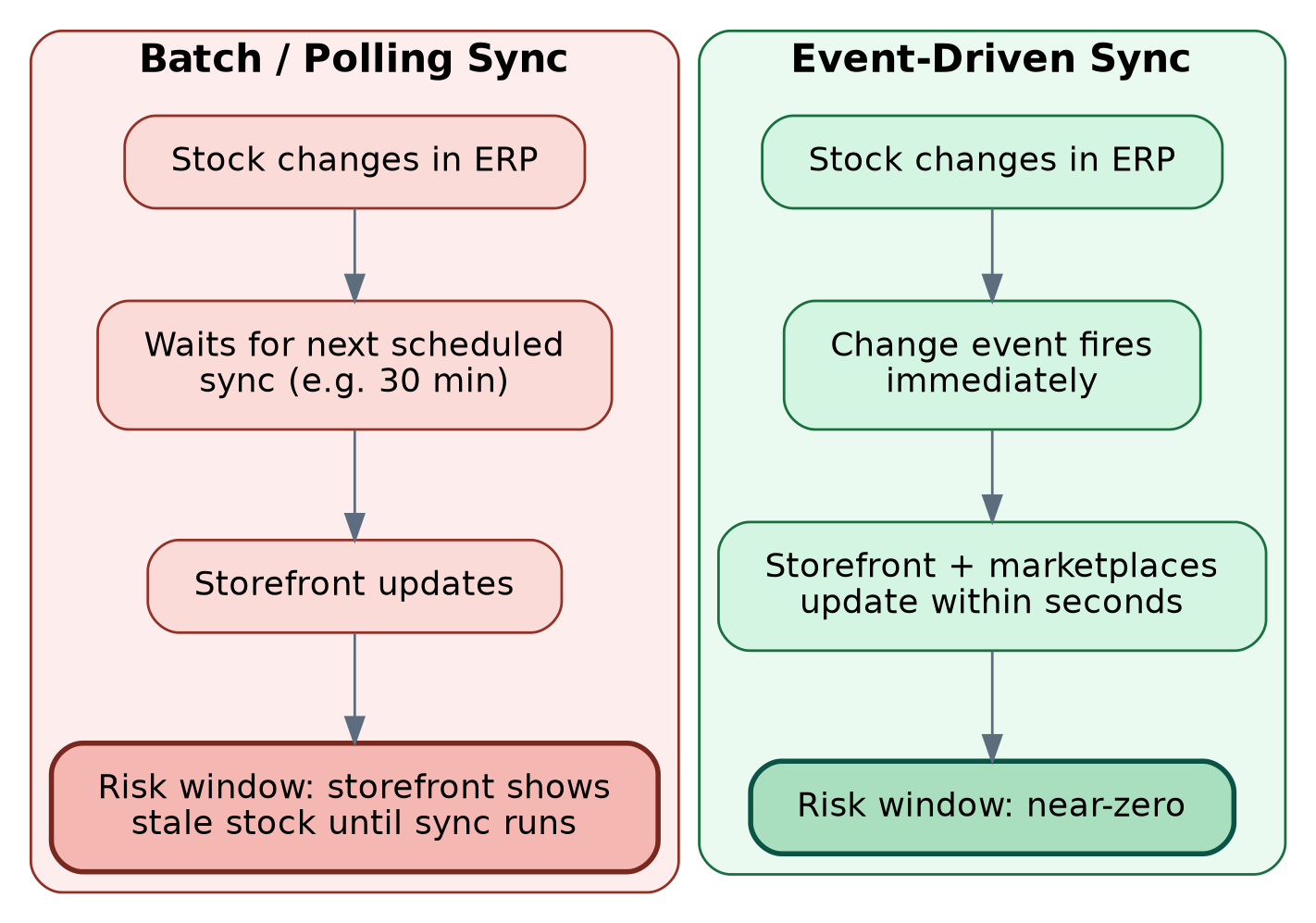
Event-driven sync is replacing batch and polling. Older integrations ran inventory or order sync on a cron schedule — every 30 minutes, every hour. That gap is exactly where overselling incidents happen: a popular item sells out mid-sale, and the storefront keeps showing it as available until the next scheduled sync catches up. Event-driven architecture reacts the moment something changes — an order placed, stock received — closing that window to seconds rather than minutes.
AI-assisted error resolution is starting to replace manual investigation queues. Integration errors — mismatched SKUs, failed syncs, timeout retries — traditionally route to a human for diagnosis. Middleware is increasingly able to diagnose and resolve these automatically, an emerging capability worth building toward even if full automation isn't there yet for every failure type.
Machine-readable product data is becoming a requirement, not a nice-to-have. As purchases increasingly get initiated through AI shopping agents rather than direct browsing, product and inventory data needs to be structured for machines to read, not just for a storefront to display — a shift Cosnet has covered in depth in Universal Commerce Protocol (UCP): What It Means for SEO and AI Shopping
How to Apply This to Your Own Store
Audit where inventory actually lives: If stock counts differ between your ERP, storefront, and marketplace listings even briefly, that gap is costing sales right now — quantify it before scoping any redesign.
Treat integration architecture as a phase, not an afterthought: The Skybags delivery process ran the integration architecture step alongside the UX work, not after it — a sequencing choice that determines whether the two efforts reinforce each other or compete for the same launch window.
Pick a sync pattern per data flow, not one setting for everything: Orders and high-velocity inventory typically warrant real-time or near-real-time sync; pricing and catalogue data can often run on a scheduled sync without business impact — real-time everything adds cost and complexity without proportional benefit.
Scope for your actual channel count now, not just today's traffic: A single-channel integration and a three-channel integration (owned store plus two marketplaces) are different architectures, not the same build with more API keys.
FAQ
Q1. What is ERP integration for e-commerce?
A. ERP integration for e-commerce is the connection between an online store and the enterprise resource planning system that manages inventory, orders, and financials, so data — stock levels, orders, pricing — flows automatically between the two instead of being entered manually in each system.
Q2. How does ERP integration work with an online store?
A. When a customer places an order, it flows from the storefront into the ERP for fulfilment and accounting, while the ERP pushes updated inventory, pricing, and product data back to the storefront — closing the loop without anyone re-keying data by hand.
Q3. How much does e-commerce ERP integration cost?
A. Straightforward integrations can start around $5,000, while enterprise-scale implementations involving platforms like SAP, Oracle, or Microsoft Dynamics represent a much larger investment, scaling with the number of sales channels, order volume, and catalogue complexity. The cost of not integrating is its own number worth weighing: a business processing 200 orders a day at roughly three minutes of manual ERP entry per order burns an estimated $75,000–$100,000 a year in labour alone.
Q4. How do I stop overselling on multiple sales channels?
A. Overselling across channels is almost always a sync-latency problem — the fix is moving inventory updates from scheduled batch syncs to real-time or near-real-time, event-driven sync, so every channel reflects a stock change within seconds rather than the next scheduled run.
Q5. What is real-time inventory sync and why does it matter?
A. Real-time inventory sync updates stock availability across every sales channel the moment a sale, return, or restock happens, rather than on a delay — it matters because the gap between an inventory change and the storefront reflecting it is exactly where both overselling and lost sales from false stockouts occur.
Q6. How do I sync inventory between my website and marketplaces like Amazon and Flipkart?
A. The reliable approach is connecting both channels to a single source of inventory truth — typically the ERP — via marketplace APIs, so a sale on either channel updates the shared stock pool immediately rather than each channel tracking inventory independently.
Q7. What's the difference between batch sync and real-time sync in e-commerce?
A. Batch sync updates data on a fixed schedule — every 30 minutes or nightly, for example — while real-time (or event-driven) sync updates the moment something changes; batch is simpler and cheaper to run, but leaves a window where displayed data doesn't match reality, which is where overselling and pricing errors happen.
Q8. How long does ERP integration take for an e-commerce store?
A. Timelines scale with scope: a basic order-and-inventory integration can run a matter of weeks, while a complex, multi-channel, multi-system integration with custom business rules can extend to several months — the biggest variable is usually how many data flows (orders, inventory, pricing, customers, shipping, returns) need to be connected.
Q9. What is composable or MACH commerce architecture?
MACH — Microservices, API-first, Cloud-native, Headless — is an architecture pattern where commerce functions like order management, inventory, and product data are built as separate, independently scalable services connected by APIs, rather than one monolithic platform handling everything.
Q9. Can AI automatically fix e-commerce integration errors?
A. Increasingly, yes for a growing subset of common failures — middleware is starting to diagnose issues like mismatched SKUs or failed syncs and apply corrections automatically, reducing what used to require manual investigation, though complex or ambiguous errors still typically need a person to resolve them.
Ready to see what connected commerce could look like for your store? Talk to our Experts.