What B2B E-Mobility Platforms Actually Need to Run — And to Grow
Most B2B e-mobility platform builds start with a vehicle question — what to build, what to source, what to brand. The harder question shows up later: what software does it take to actually run a fleet once riders, operators, and commercial partners are all pulling on the same system at once — and once it's running, how do the right partners and riders actually find it?
That combination — the platform and the pipeline to fill it — is where most e-mobility teams end up stitching together separate vendors. It's also the exact intersection we work in daily: building the operational software and running the digital marketing that gets it in front of the right B2B buyers. What follows is less theory and more a working breakdown, grounded in a live 25,000-rider deployment.
The global shared micromobility market is on a steep climb — from roughly $8 billion in 2025 toward an estimated $24 billion by 2036 — and commercial, B2B-driven fleets are expected to account for the majority of that demand in 2026, not individual casual riders. E-bikes specifically are pulling ahead of scooters as the preferred shared vehicle in several markets, thanks to better unit economics and lighter regulatory friction. That shift matters, because a platform built only for consumer convenience breaks the moment a hotel, university, or logistics partner needs to run its own fleet inside it.
The Four Systems a B2B E-Mobility Platform Actually Needs
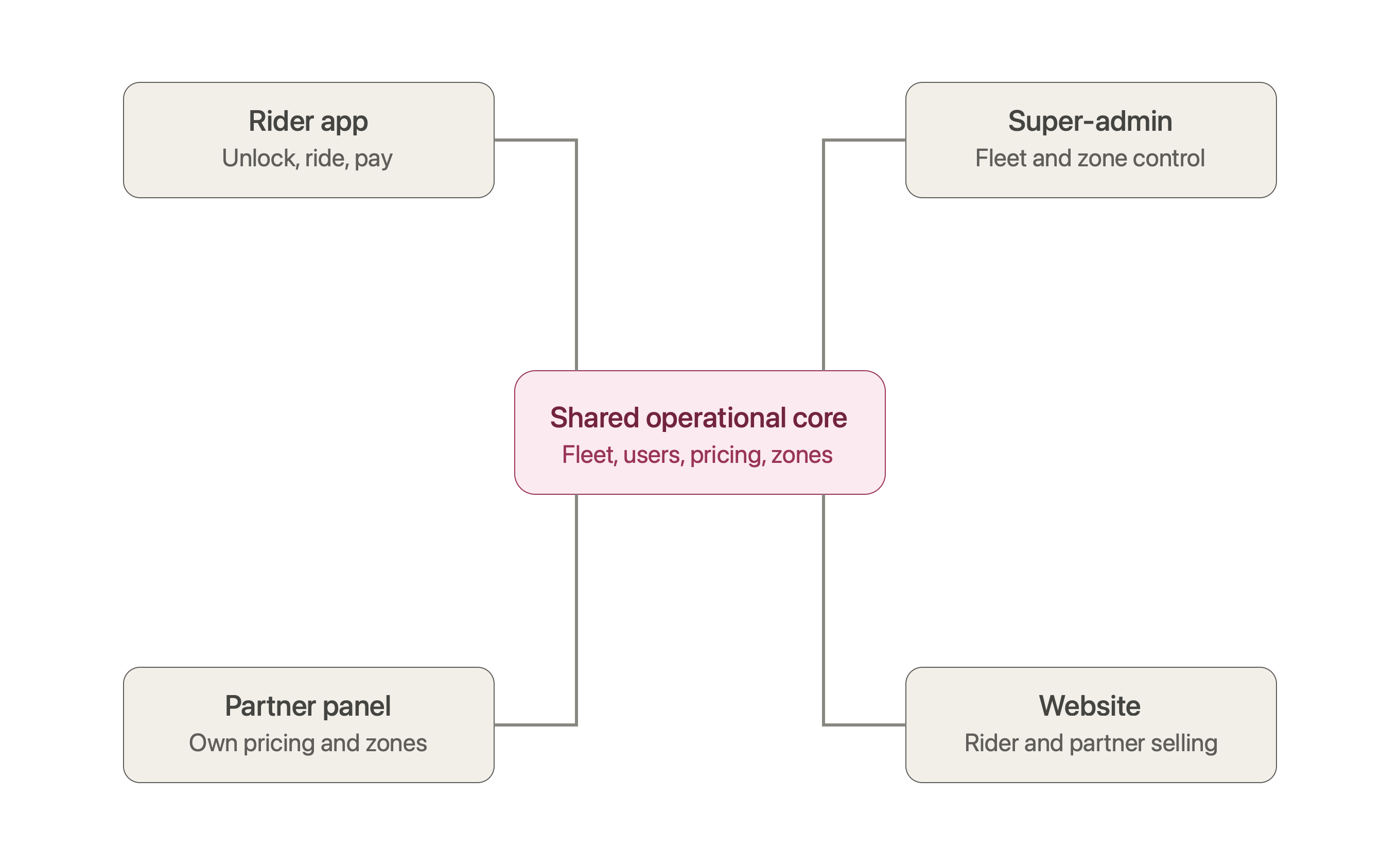
A shared e-bike or e-scooter business isn't one product — it's four interlocking ones, each with a different user and a different failure mode.
1. Rider Experience Discovery, booking, QR-based unlock, ride tracking, and payment — all in one flow with as few taps as possible. Every extra step here is a rider who walks away.
2. Fleet Operations (Super-Admin) Central visibility into every bike's location, battery, maintenance status, and revenue — plus the ability to set pricing and geo-fenced zones without touching code.
3. Partner Management Hotels, campuses, and corporate sites increasingly want their own mini-fleet inside the larger network — their own pricing, their own service zones, their own customers — without operating a separate platform.
4. Customer-Facing Website The layer that actually sells the service to both individual riders and prospective commercial partners, distinct from the operational app.
Miss one of these four and the gap shows up as a support ticket, not a strategy slide — a partner who can't set their own pricing, a fleet manager flying blind on maintenance, or a rider who abandons a booking mid-flow.
A Working Example: Elby Mobility
Elby Mobility — a Magna International e-mobility venture operating in Canada — needed exactly this: a system simple enough for riders to unlock and ride in seconds, while giving operations teams and third-party partners full control over fleets, pricing, and zones.
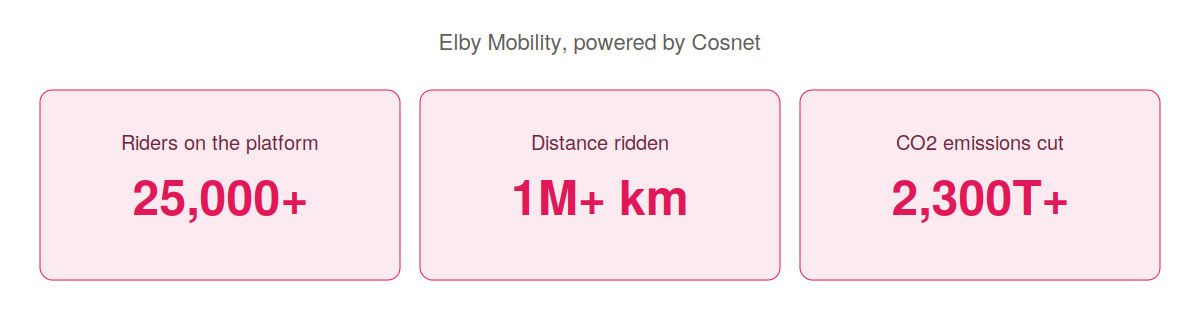
Cosnet built all four layers as one connected system rather than four separate tools bolted together:
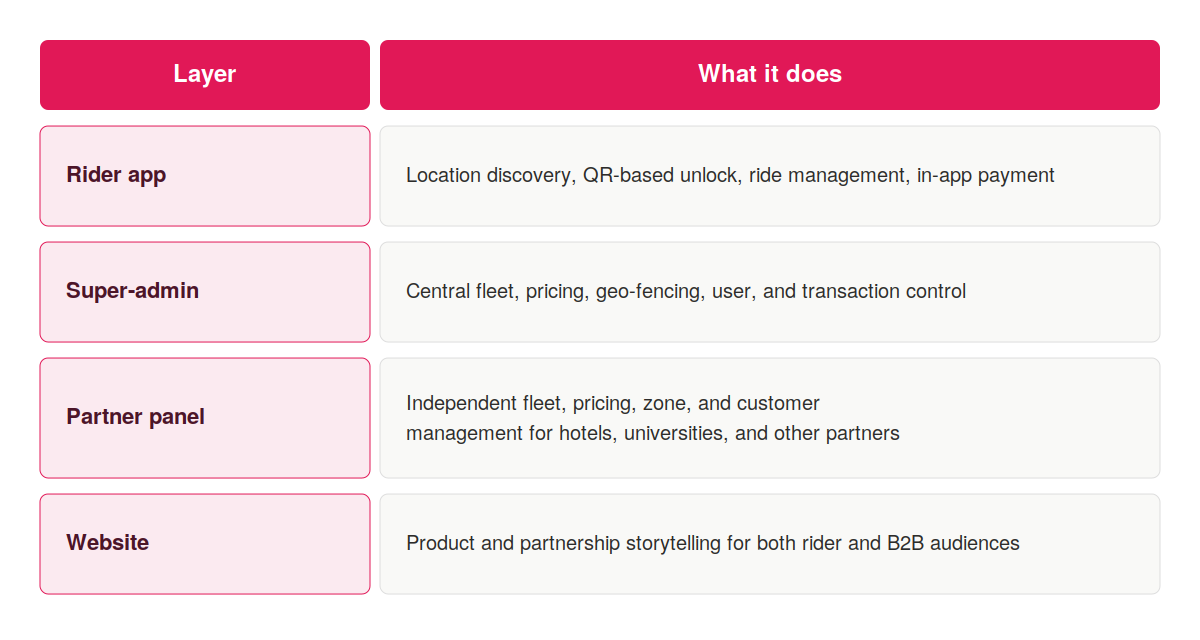 The numbers that came out of it: 25,000+ riders, 1 million+ km ridden, and 2,300+ tonnes of CO₂ emissions cut, powered by a shared operational core that lets Elby add bikes, zones, and partners without rebuilding the platform for each new rollout.
Why "Shared Core, Separate Panels" Beats Building Fresh for Every Partner
The instinct, when a new commercial partner signs on, is to spin up a custom build for their specific pricing and zone rules. That's the pattern that eventually buries an operations team.
A shared operational core — one data layer for bikes, users, pricing, and zones, exposed through different panels for admin and partner roles — means:
- New partners onboard in days, not a fresh build cycle. The partner panel is a role, not a project.
- One source of truth for fleet health. Operations doesn't reconcile numbers across four separate tools.
- Geo-fencing and pricing changes apply instantly without a deployment for every zone tweak.
This is also where regulatory friction tends to surface first — city and municipal rules on where shared vehicles can operate are tightening, which is a direct driver of demand for platforms with built-in, self-service geo-fencing rather than manually managed zone lists. It's the same pattern showing up across connected fleets more broadly, where AI-driven routing and predictive maintenance are increasingly what separates an operationally lean fleet from one drowning in manual checks.
Where AI Actually Earns Its Keep in a Fleet Like This
"AI" gets attached to almost every mobility pitch deck now, but on a real deployment, it tends to show up in a handful of concrete places rather than as one big feature:
- Demand-and-rebalancing prediction — forecasting where bikes will be needed by hour and zone, so redistribution crews move vehicles before a shortage happens, not after.
- Predictive maintenance — flagging battery degradation, brake wear, or lock failures from usage patterns before a rider hits a dead bike mid-ride.
- Dynamic, zone-aware pricing — adjusting rates by demand, weather, or time of day without an operator manually touching a dashboard.
- Partner-side reporting and anomaly detection — surfacing unusual usage or revenue patterns for a hotel or campus partner automatically, instead of them requesting a manual export.
None of this requires an AI overhaul on day one. As an AI-native development team, our approach is usually to wire the data pipeline for it from the start — fleet, ride, and partner data flowing into one place — so these capabilities can be switched on incrementally as the fleet scales, rather than requiring a platform rebuild later.
Getting Found by the Partners Who Actually Move the Needle
A well-built platform still needs the right hotels, campuses, and corporate sites to know it exists — and B2B mobility buyers don't discover partners the way individual riders discover an app.
A few things tend to matter more here than in consumer marketing:
- Case-study-led content, not feature lists — a facilities manager or partnerships lead wants to see a comparable deployment's numbers, not a spec sheet.
- Search visibility for operational questions — "e-bike fleet partner program," "campus micromobility vendor" — the terms a partnerships team actually types, not brand-name searches.
- LinkedIn and direct outreach to the actual decision-maker, since fleet partnership deals are usually relationship-led, not self-serve sign-ups.
This is the piece that tends to get bolted on late, if at all, once the platform itself is live — worth building in parallel through a digital marketing approach built for B2B decision-makers, not consumer app-store discovery.
What This Means for a B2B Mobility Roadmap
For a team weighing what to build first, the sequence that tends to hold up:
- Rider flow first — discovery, unlock, payment. This is the product's entire first impression.
- Admin controls second — fleet, pricing, and zones need to be operator-editable from day one, not hardcoded.
- Partner panel third — build it as a permission layer on the same core system, not a parallel build.
- Website last, but not least — it's doing commercial selling work, not just marketing decoration, once partners are part of the model.
Subscription and B2B corporate mobility models are also gaining ground over pure pay-per-ride, which raises the bar on what the partner and pricing layers need to support from the start — flat-rate zones, corporate billing, and usage reporting, not just per-minute charges. Once that base is in place, the same demand-forecasting and predictive maintenance techniques reshaping supply chains apply almost directly to fleet redistribution and battery servicing.
FAQ
Q1. Should we build a custom e-mobility platform or buy an off-the-shelf one?
A1. It depends on whether the platform is core to how you differentiate. Standard rider apps with no partner layer are commodity territory where buying makes sense. Once commercial partners need independent pricing, zones, and reporting — the kind of setup Elby needed — most off-the-shelf tools hit their ceiling fast, and a shared-core custom build pays back the investment.
Q2. How much does it cost to build a B2B e-mobility platform?
A2. Costs vary widely by scope, but the biggest cost driver isn't the rider app — it's the admin and partner layers. A platform with only a consumer booking flow costs a fraction of one built for multi-partner fleet operations, geo-fencing, and role-based access from day one.
Q3. How long does it take to onboard a new commercial partner once the platform is live?
A3. On a platform with a shared operational core and a dedicated partner panel, onboarding is largely a configuration exercise — setting pricing, zones, and users — rather than a new development cycle.
Q4. What should an e-mobility platform's AI roadmap actually include?
A4. Start with demand-and-rebalancing prediction and predictive maintenance, since they have the clearest, fastest ROI. Dynamic pricing and partner-side anomaly detection typically come next, once the underlying fleet and ride data is flowing into one place rather than scattered across tools.
Q5. How do B2B e-mobility companies typically evaluate a technology and marketing partner?
A5. Beyond a portfolio, most look for evidence that the partner understands both sides of the problem — the operational software and how it gets discovered by partners and riders. A platform with no demand strategy behind it stalls the same way a marketing effort with no product to sell does.
The platform and the pipeline to fill it aren't separate problems — they're the same business problem viewed from two ends, which is why we tend to work on them together rather than handing a finished platform off and calling it done.
Ready to see what a connected e-mobility platform — and the demand to fill it — could look like for your fleet? Talk to our Experts.