

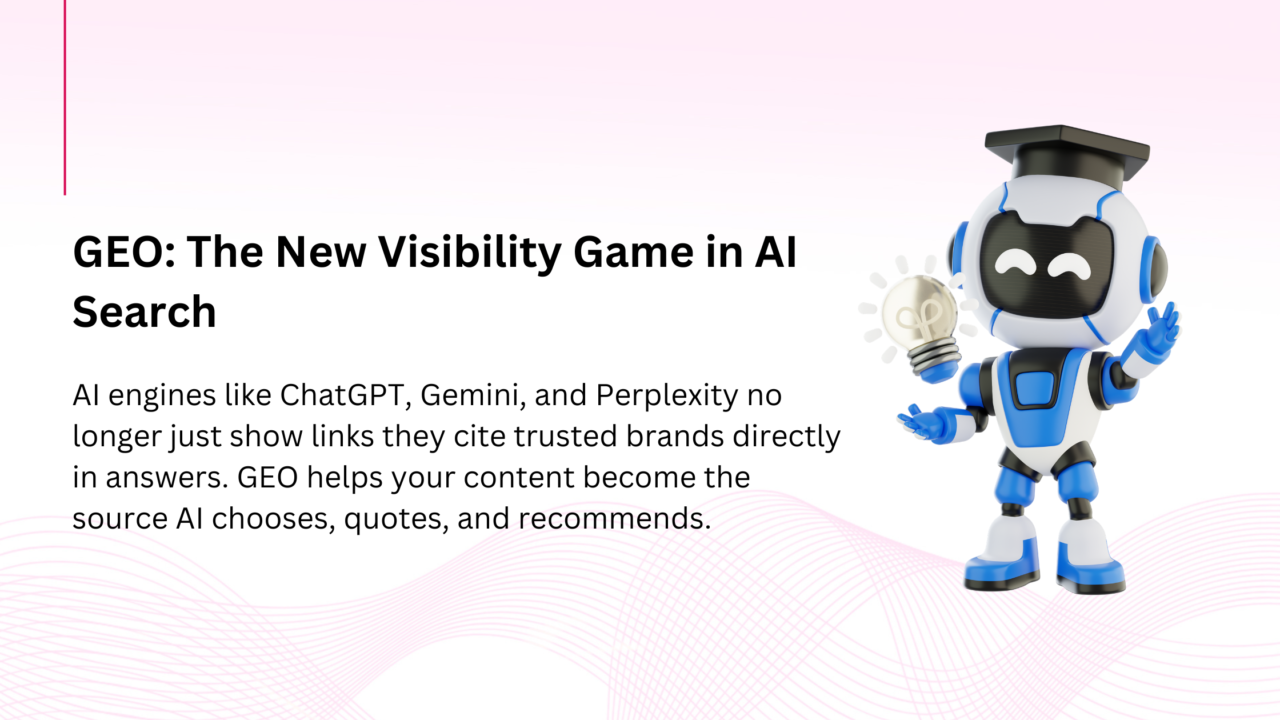
Generative Engine Optimization (GEO) is the practice of structuring your content so that AI-powered answer engines — ChatGPT, Google Gemini, and Perplexity — cite your brand when generating responses to user queries. In 2026, it is the most significant shift in search marketing since PageRank, and brands that have not yet built a GEO strategy are losing visibility to competitors who have. Enterprise teams navigating AI adoption are already feeling this across every layer of their operations — from Shadow IT and AI governance to how marketing budgets are allocated.
This guide explains what GEO is, why it matters, how it differs from traditional SEO, and the practical steps you can take to start optimising for AI-generated answers today.
Why GEO Exists: The Search Landscape in 2026
For two decades, ranking on Google’s first page was the central goal of digital marketing. That model is not dead — but it is being disrupted at a fundamental level.
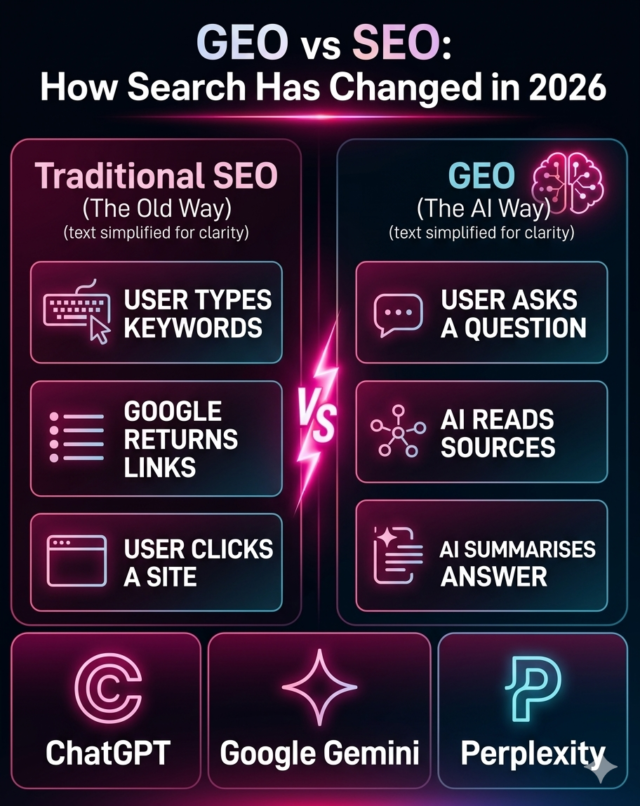
In 2026, a growing proportion of information-seeking behaviour ends not with a click on a blue link, but with an AI-generated answer. When someone asks ChatGPT “what is the best app development agency in India” or asks Perplexity “how does Shadow IT affect enterprise security,” the AI does not return a list of URLs. It synthesises information from hundreds of sources and produces a direct answer.
If your brand is not one of the sources that AI systems trust and reference, you are invisible to that user — regardless of where you rank on traditional Google search.
The scale of this shift is measurable. Google AI Overviews now reach more than 2 billion monthly users. ChatGPT serves 800 million users each week. And according to Gartner, traditional search engine volume is predicted to drop 25% in 2026 as users shift to AI-powered answer engines. A 2023 study by Princeton, Georgia Tech, and IIT Delhi — the first major academic research on GEO — found that content optimised for generative engines saw up to 40% improvement in citation frequency in AI-generated responses.
GEO vs SEO vs AIO: What Each Term Actually Means
These three terms are frequently confused. Here is a clear distinction.
Traditional SEO focuses on ranking in Google’s organic search results — the ten blue links. It is driven by keywords, backlinks, technical performance, and E-E-A-T signals. It remains important and should not be abandoned.
AI Overview Optimization (AIO ) focuses specifically on appearing in Google’s AI-generated summaries at the top of search results. Google AI Overview SEO is a platform-specific strategy that works alongside GEO but is not the same discipline.
Generative Engine Optimization ( GEO) is broader. It covers optimisation for any generative AI system that produces answers — including ChatGPT, Perplexity, Claude, Gemini, and Meta AI. GEO is not limited to Google. It is about being the trusted source that AI systems draw from regardless of which platform a user chooses.
The three disciplines overlap significantly — strong GEO practice reinforces both SEO and AIO. But GEO requires thinking about content differently: not as content that ranks for a keyword, but as content that an AI would choose to quote, summarise, or cite when answering a related question.
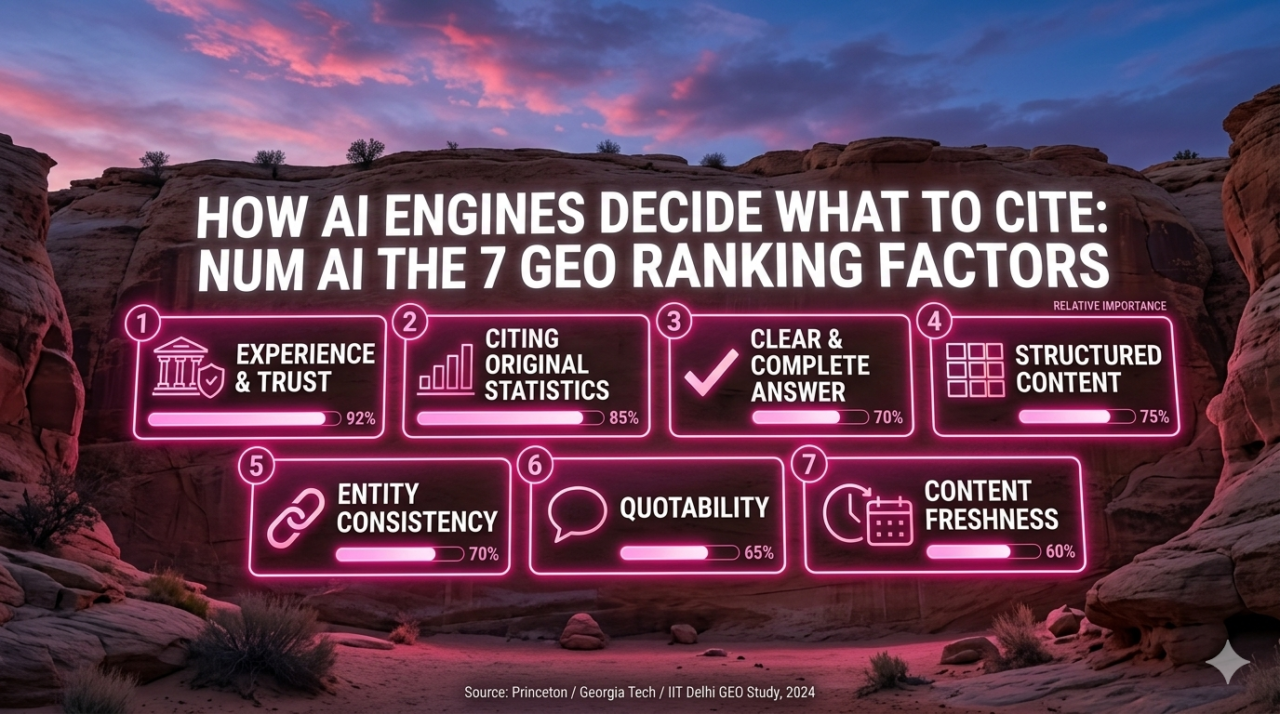
The 7 Factors That Drive GEO Performance
The Princeton/Georgia Tech/IIT Delhi study tested nine distinct strategies across 10,000 search queries and 2,800 sources. The strategies that most consistently improved AI citation frequency were the following.
1. Authoritative, Cited Statistics
AI systems are trained to avoid hallucination. When a source includes a verifiable statistic with clear attribution, the AI can cite it with confidence. Example: “according to the IBM Cost of a Data Breach Report 2024, the average enterprise data breach cost $4.88 million.” Replacing every vague general claim with a sourced figure is one of the highest-impact GEO changes you can make.
2. E-E-A-T Signals
Google’s E-E-A-T framework — Experience, Expertise, Authoritativeness, Trustworthiness — is used by AI systems to assess whether a source is trustworthy enough to cite. Practical E-E-A-T signals include: named authors with LinkedIn profiles, current publication and update dates, statements of first-hand experience, and consistent brand entity signals throughout the content.
3. Quotable, Self-Contained Statements
AI engines extract specific statements that can stand alone as a concise answer — they do not reproduce entire paragraphs. A quotable statement is short (one or two sentences), specific, and understandable without surrounding context. Structure your content to include at least one clearly quotable sentence per major section.
4. Structured Content and Schema Markup
Content with clear H2/H3 headings, numbered lists, comparison tables, and FAQ sections consistently performs better in GEO. Schema markup amplifies this — FAQPage, Article, HowTo, and BreadcrumbList schema all provide machine-readable context that AI crawlers interpret with higher confidence. Cosnet’s AI Services team implements structured data architecture as part of AI-era digital builds.
5. Entity Consistency
AI systems build knowledge graphs by mapping entities — brands, people, products, concepts — and their relationships. Content that references your brand name, services, and expertise consistently and precisely trains AI systems to associate your brand with those topics. Always use the same version of your brand name. Always describe your services the same way across every page.
6. Answer Completeness
AI engines favour sources that completely answer a question over those that partially address it. A page that thoroughly covers a topic — including edge cases, common objections, and follow-up questions — is more likely to be cited than one that covers only the basics.
7. Content Freshness
AI systems weight recent content more heavily for time-sensitive queries. Add a “Last updated” timestamp to important pages, refresh statistics annually, and add a brief update section to any evergreen content where significant developments have occurred.
How GEO Fits Into Your Broader Digital Strategy
GEO works best when it sits on top of a strong content and SEO foundation. The connection between GEO and first-party data in AI marketing is particularly important: proprietary data and original insights make your content impossible to replicate, which is the single strongest GEO signal available.
For e-commerce brands, GEO and Google’s emerging Universal Commerce Protocol work in tandem — UCP structures product data for AI shopping agents, while GEO structures editorial content for AI answer engines. Together they form a complete AI-era visibility strategy.
For brands already running AI agent-powered marketing, a strong GEO foundation makes those AI investments significantly more effective — because the AI agents are operating in an environment where your brand is already trusted and cited externally.
A Practical GEO Implementation Framework for 2026
The following framework is designed to be implemented progressively — starting with the highest-impact changes and building toward a comprehensive GEO strategy over a 90-day period.
Phase 1 — Days 1–30: Audit and Structure
Audit your top 10 pages against five GEO criteria: cited statistics, named author credentials, quotable statements, structured headings, and FAQ sections. The pages that fail are your highest-priority optimisation targets. Implement Article and FAQPage schema across all blog posts this month.
Phase 2 — Days 31–60: Build Citable Assets
Create content specifically designed for GEO: original research or data pieces (even a small client survey produces statistics no one else can cite), comprehensive “What is X” definitional posts, and named expert opinion pieces with specific, quotable statements per section.
Phase 3 — Days 61–90: Authority and Monitoring
Publish on LinkedIn and relevant industry publications to build external entity signals. Then monitor by manually testing queries in ChatGPT, Gemini, and Perplexity. Track AI referral traffic in GA4 by filtering for ChatGPT-User, PerplexityBot, and ClaudeBot user agents.
5 GEO Mistakes That Will Cost You Citations
Treating GEO as a keyword game. AI systems are not looking for keyword matches — they are looking for trusted, accurate, comprehensive sources. Keyword stuffing actively harms GEO performance.
Publishing without author attribution. Anonymous content performs significantly worse in GEO. Named authors with credentials and LinkedIn profiles are a fast, high-impact fix.
Google-only optimisation. Perplexity’s growth and ChatGPT’s query volume mean your GEO strategy must extend beyond Google AI Overviews. Optimise for the ecosystem, not one platform.
Failing to update content. AI systems downgrade outdated sources for time-sensitive queries. A blog with 2023 statistics will lose citations to a fresher piece on the same topic. Regular refreshes are not optional.
Blocking AI crawlers. Check your robots.txt file to ensure GPTBot, ClaudeBot, and PerplexityBot are not blocked. Many Cloudflare configurations block AI crawlers by default — check your AI Crawl Metrics page in the dashboard.
FAQs
1. What is Generative Engine Optimization in simple terms?
Generative Engine Optimization (GEO) is the practice of optimising your content so that AI-powered answer engines — ChatGPT, Google Gemini, and Perplexity — cite your brand when generating responses to user questions. Where traditional SEO gets your page to rank in search results, GEO gets your content quoted inside AI-generated answers.
2. How is GEO different from traditional SEO?
Traditional SEO focuses on ranking in Google’s organic results and earning clicks. GEO focuses on being cited by AI answer engines. GEO requires greater emphasis on content credibility signals, structured writing, cited statistics, and named authorship. The two disciplines are complementary — strong SEO foundations support GEO, and strong GEO signals improve E-E-A-T, which benefits SEO.
3. Which AI platforms does GEO apply to?
In 2026, the primary platforms are Google Gemini, ChatGPT, Perplexity AI, Claude, and Meta AI. As vertical AI search tools emerge in legal, medical, and financial services, GEO will extend to those ecosystems as well.
4. How long does GEO take to show results?
Structural and content changes typically become visible in AI citations within 60 to 90 days. Building competitive citation authority for high-volume queries takes six to twelve months of sustained effort. The investment compounds — GEO foundations also improve traditional SEO performance, so every change earns returns in both channels.
5. Is GEO relevant for B2B companies?
GEO is highly relevant for B2B — arguably more so than B2C in certain contexts. Enterprise buyers increasingly use AI platforms to research vendors before contacting a company. A brand cited in an AI answer to “best enterprise app development agency India” is reaching a decision-maker at the exact moment of research intent.
Is your brand invisible to AI search engines?
Cosnet’s digital marketing team specialises in building AI-era content strategies — from GEO foundations to full content architectures that make your brand the source AI engines trust.
Generative Engine Optimisation is not a trend to monitor from the sidelines. It is a discipline to implement now, while the competitive landscape is still being defined. The brands that build GEO authority in 2026 will be the brands that AI engines default to in 2027 and beyond — because authority, once established in an AI knowledge graph, compounds in ways that are difficult for late movers to overcome.
The search landscape has changed. The question is whether your content strategy has changed with it.
