

Your competitor just added a digital employee that never sleeps, never misses a follow-up, and costs less than a monthly coffee budget. Agentic AI for business is what that digital employee actually is — and in 2026, it is no longer a pilot programme running in one department. It is how fast-moving companies operate across sales, support, and operations at the same time. If you have already been thinking about how Generative Engine Optimization is changing the way customers find you, agentic AI is what happens after they do — the operational layer that runs the moment someone shows intent.
This guide explains what an AI agent actually is, how it differs from automation tools you already use, what it costs to deploy, and how to get the first one into production without wasting six months on the wrong workflow.
What Makes Agentic AI for Business Different From Standard Automation
Most businesses already use automation. Zapier runs if-then rules. Scheduled reports send themselves. Forms trigger email sequences. This is not agentic AI.
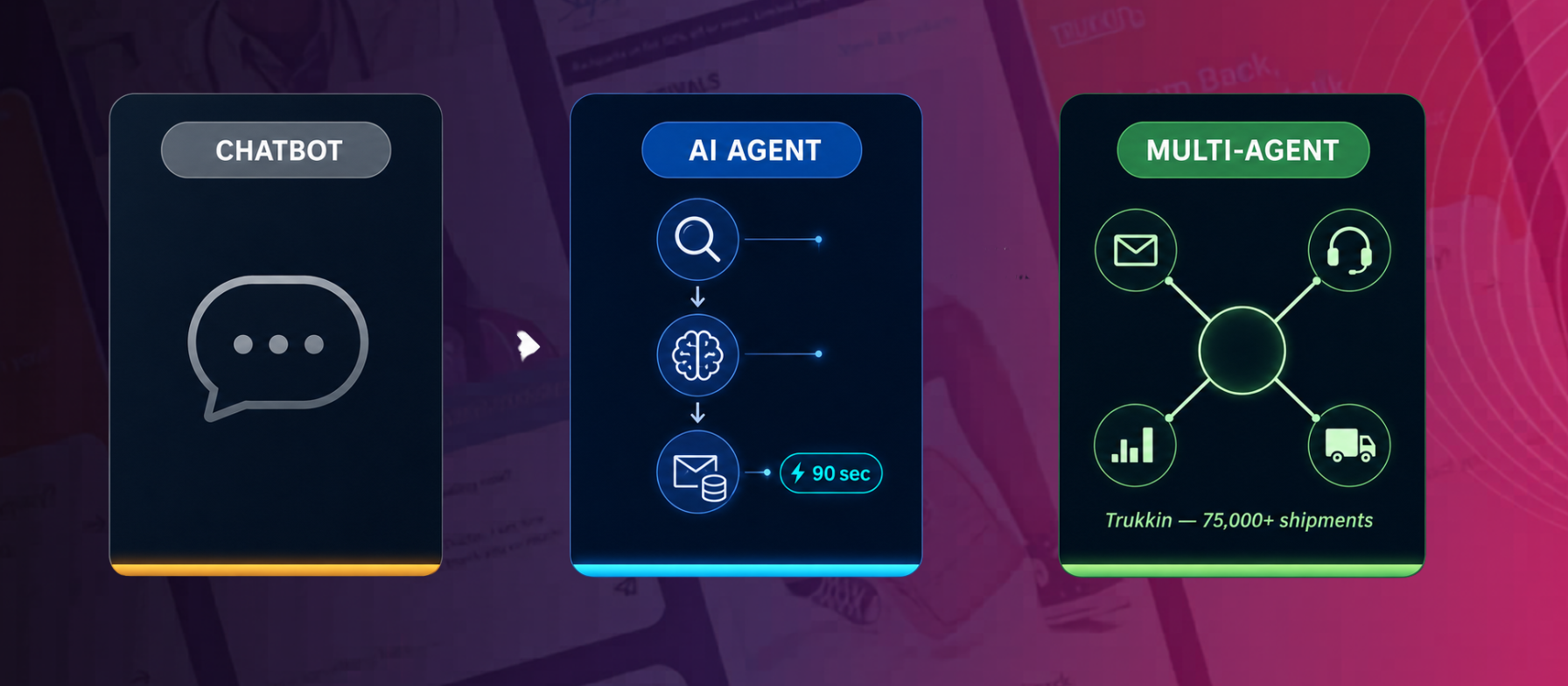
The distinction matters because it changes what you can delegate. A standard automation tool follows a fixed script — if this happens, do that. It breaks the moment conditions change. An AI agent takes a goal and works toward it — across multiple steps, multiple tools, multiple systems — making judgment calls along the way without a human directing each one.
The clearest example: a lead fills out your contact form. An automation tool sends a confirmation email and logs the entry — and stops there. An AI agent reads the form, looks up the company on LinkedIn, scores the lead against your ideal customer profile, drafts a personalised outreach email, logs everything to your CRM, and pings the right sales rep — in under 90 seconds. No human involved.
That gap is what agentic AI for business closes. It is the difference between a vending machine and a new hire who figures out what needs doing next.
Why 2026 Is When Businesses Stop Experimenting
The economics have shifted enough that agentic AI is no longer enterprise-only. According to Grand View Research, the global AI agent market is projected to reach $199 billion by 2034, up from $5.25 billion in 2024. Gartner forecasts that 40% of enterprise applications will have embedded AI agents by end of 2026. McKinsey’s State of AI Report 2026 puts current adoption at 79% of organisations reporting some level of agentic AI activity. And per Andreessen Horowitz, AI model costs have dropped over 90% since early 2024 — making agents viable for a five-person startup, not just Fortune 500s.
The era of “we are exploring AI” is over. The question is no longer whether — it is how fast, and which workflow first.
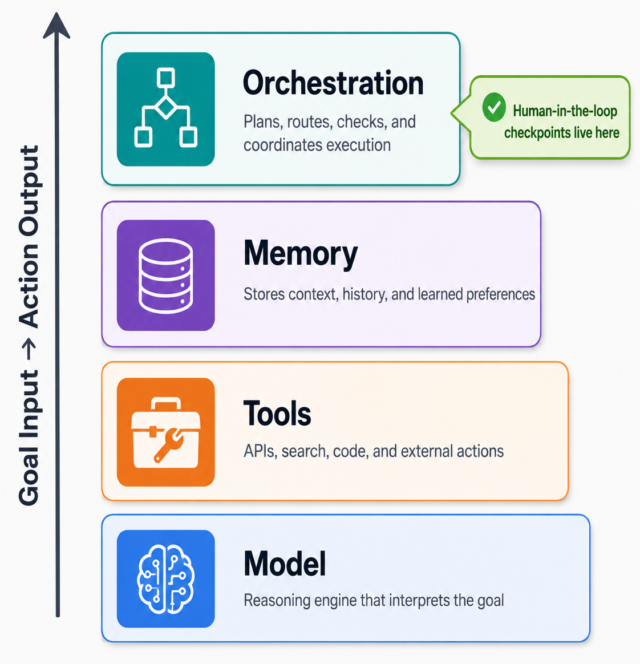
The 4 Layers Inside Every AI Agent
Understanding what is under the hood helps you deploy smarter and scope correctly with a development partner.
1. The Model
The reasoning brain — GPT-4o, Claude, Gemini. It interprets the goal and decides what to do next. On its own, it only produces text. The other three layers are what make it act.
2. The Tools
The agent’s arms and legs. APIs and integrations that let it do things in the real world: send emails, update your CRM, query a database, run a web search, trigger a payment. Without tools, an agent can only think — it cannot execute.
3. The Memory
Short-term context (what is happening in this task right now) and long-term recall (what happened in previous interactions). Without memory, the agent forgets mid-task. With it, an agent can handle a multi-day customer onboarding sequence and remember every step.
4. The Orchestration
The workflow logic — when to call which tool, how to handle errors, when to stop and escalate to a human. In 2026, the most effective deployments use multi-agent systems: one lead orchestrator routing tasks to specialist sub-agents, each owning one job and executing it reliably. Think of it as a team, not a solo hire.
6 Agentic AI Use Cases Running in Real Businesses Today
These are not proof-of-concepts. These are live deployments.
Lead Qualification and Outreach
Agents enrich, score, and personalise outreach to inbound leads within minutes of form submission. For a ten-person sales team, this is the output equivalent of two full-time SDRs — without the hiring cost or ramp time.
Customer Support Tier 1
Not the ‘I’m sorry, I don’t understand that’ chatbot generation. Current agents resolve first-line support tickets autonomously: checking order status, processing refunds, searching knowledge bases, escalating only what genuinely needs a human judgment call.
Content Research and Briefs
Agents scan competitors, pull keyword gaps, check current search intent, and produce a structured content brief — in the time it used to take a strategist to open a spreadsheet. Editorial teams keep the judgment. The agent handles the groundwork.
Finance and Invoice Automation
Invoices read from email, matched to purchase orders, flagged for discrepancies, pushed to accounting software. DBS Bank and Visa have both run live agentic commerce trials at scale in 2025–26, establishing the pattern that mid-market finance teams are now implementing.
Talent Screening
CVs processed, candidates scored against role criteria, interview slots booked, hiring managers briefed. Documented enterprise deployments have cut time-to-hire by 40–60% using this workflow alone.
Operations Monitoring and Response
Agents watch live data streams and trigger responses autonomously — rerouting a shipment, reordering stock below threshold, alerting the ops team to an anomaly before it becomes a problem.
| Cosnet in production: Trukkin
We built the real-time operations command layer for Trukkin, managing 75,000+ shipments across the Middle East. The agent stack monitors live logistics data, triggers autonomous responses, and escalates only when human judgment is required. This is not a demo — it is the architecture running in production today. |
The broader pattern is consistent with what Harvard Business Review reported in March 2026: the businesses winning with AI agents are not the ones replacing their people — they are the ones using agents to free their people for higher-value work. Agentic AI for business performs best when the scope is narrow and the human role is redefined, not eliminated.
What Agentic AI for Business Actually Costs
The biggest misconception is that agent deployment requires an enterprise budget. It does not. Agent tooling starts at $20 per month per agent, and a practical three-workflow stack covering lead follow-up, support triage, and content research runs between $200 and $500 per month — a fraction of a single new hire, with measurable output from week one.
The real cost is not the software. It is implementation done incorrectly. A poorly scoped agent touching live customer data without oversight costs far more in clean-up than it saves in efficiency. The investment worth making is getting the first deployment right — narrow scope, correct integrations, governance built in from the start.
3 Things That Will Break Your Deployment
No governance from day one: Every agent needs a defined scope, a named human owner, and logged actions. Companies that skip this lose months recovering from production incidents. Shadow IT and AI governance is the exact challenge that surfaces when agents are deployed without these controls. Cosnet’s AI agent development practice builds governance in from sprint one — not after something breaks.
Bad data going in: An agent running on messy data automates your mess at scale. Your first-party data strategy needs to be clean and centralised before you deploy. Always the prerequisite — never the afterthought.
One agent trying to do everything: The ‘digital employee that does it all’ makes a great demo. In production, it is a reliability disaster. One agent, one function — that is the architecture that ships and performs. Focus is what makes agents trustworthy in live customer workflows.
FAQs
What is agentic AI in simple terms?
An AI agent takes a goal and completes it — across multiple tools and steps — without human input at each stage. It plans, acts, checks results, and adjusts. Where a chatbot responds to a question, an agent executes a workflow. The distinction is autonomy: an agent does not wait to be told what to do next.
How is an AI agent different from Zapier or Make?
Zapier and Make follow rigid if-then rules and break when conditions fall outside the script. An AI agent handles variation, understands context, and makes judgment calls. Automation is a vending machine — it dispenses what you programmed. An agent is closer to a junior employee who reads the situation and figures out the next step.
What should a business automate first?
The workflow that happens most often, takes the most time, and follows a consistent pattern. Lead qualification and first-line customer support win for most businesses — high frequency, low variability, measurable output. Build one agent, measure it, then expand. Trying to automate everything at once is how deployments fail.
How long does it take to build and deploy an AI agent?
A focused single-workflow agent — properly scoped, integrated, and tested — typically takes four to eight weeks from kickoff to production. The timeline extends when scope is unclear or existing systems lack documentation. Starting narrow means starting faster.
Will AI agents replace my team?
Not the way most people fear. Agentic AI replaces repetitive, high-volume, rule-following tasks — not judgment, creativity, or relationship management. The businesses winning with AI agents are the ones using them to free their people for higher-value work. The team stays; the allocation of their time changes fundamentally.
Ready to deploy your first AI agent?
Cosnet builds agentic AI systems for businesses across India, the USA, UK, and the Middle East — from single-workflow MVPs to full multi-agent architectures. Governance, integrations, and testing built in from day one.
The businesses deploying agentic AI now will be operating at a structural advantage in 2027 that late movers will find very hard to close.
Talk to our team about how to build your first AI agent — from scoping to production.