How AI Agents Scale Marketing ROI through AI Marketing Transformation
In 2026, the competitive frontier in digital growth has moved from simple data acquisition to agentic execution. By prioritizing AI Marketing Transformation, organizations can integrate Large Action Models (LAMs) into their stack to bypass traditional data latency. This brief outlines the transition from passive analytics to generative AI agents development and the infrastructure required to scale an autonomous growth engine.
From Passive Data to Active Intelligence
The foundation of modern growth remains first-party data for AI marketing. However, many enterprises face a “utilization gap”—they possess deep insights but lack the speed to activate them. Traditional digital marketing models are often siloed, resulting in fragmented customer journeys and missed conversion windows.
The evolution toward AI Marketing Transformation requires a shift in how we define automation. Where traditional workflows are reactive and rule-based, AI agents in digital marketing are goal-oriented. These systems do not wait for triggers; they analyze predictive intent to proactively shape the user experience.
The Three-Tier Architecture of Autonomous Growth
To scale effectively in 2026, an autonomous ecosystem must move beyond simple “if-then” automation. Cosnet implements a hierarchical model that ensures data isn’t just stored, but is contextually understood and instantly acted upon.
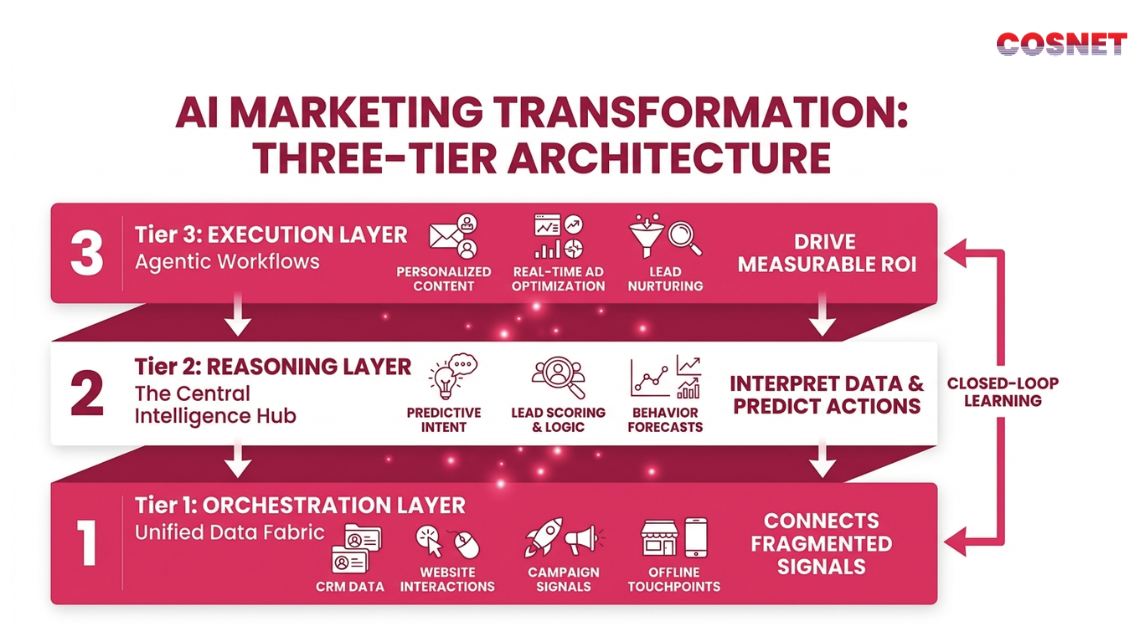 1. The Orchestration Layer: Constructing the Data Fabric
The Orchestration Layer is the “central nervous system” of your marketing infrastructure. Most enterprises suffer from fragmented data customer signals trapped in separate silos like CRMs, social media analytics, and web logs.
- Unified Data Fabric: This layer harmonizes disparate signals into a single, cohesive stream. By consolidating first-party data for AI marketing, you eliminate the “blind spots” that cause disjointed customer experiences.
- Real-Time Synchronization: This layer is responsible for maintaining the flow. It ensures that when a user interacts with your brand on one channel, the insight is immediately available to every other system, preventing the “stale data” problem.
2. The Reasoning Layer: The Central Intelligence Hub
Once the data is unified, the Reasoning Layer provides the “brainpower.” This is where generative AI models interpret raw signals to understand the why behind customer behavior.
- Predictive Outcomes: Instead of just reporting what a user did, this layer uses predictive intent to forecast what they will do next.
- Scoring and Logic: By scoring intent in real-time, the system determines the “Next Best Action.” For example, it can identify if a user is showing signs of churn or if they are entering a high-value purchase window, allowing for immediate strategic shifts.
3. The Execution Layer: Agentic Workflows in Action
The final tier is where the strategy becomes ROI. This is the realm of generative AI agents development, where Large Action Models (LAMs) take the “reasoning” from the previous layer and turn it into a tangible outcome.
- Autonomous Deployment: These specialized agents don’t just alert a human team; they act. Whether it’s adjusting a bid on a high-intent keyword or generating a hyper-personalized landing page, the AI agents in digital marketing handle the execution.
- Closed-Loop Optimization: The Execution Layer feeds results back into the Orchestration Layer. This creates a self-learning loop where the AI-assisted digital marketing system gets smarter—and more profitable—with every interaction.
Overcoming the Data Latency Bottleneck
The primary technical obstacle to achieving high-ROI AI-assisted digital marketing is Data Latency. When legacy systems rely on batch processing, AI agents are forced to operate on “stale” information, undermining the accuracy of Large Action Models.
Strategic Insight: According to Gartner’s research on real-time data, organizations must adopt event-driven architectures to remain competitive. By streaming data through real-time pipelines, agents can react to live customer signals, significantly reducing the cost-per-acquisition (CPA) and increasing lifetime value (LTV).
Conclusion: Engineering the Future of Growth
The transition to an agentic marketing model is a structural necessity for the modern enterprise. It requires a move away from isolated campaigns and toward self-optimizing systems that learn and adapt in real-time.
At Cosnet, we partner with organizations to design the data orchestration and AI infrastructure necessary to navigate this shift. By focusing on technical integrity and scalable architecture, we turn complex data signals into measurable business outcomes. Modernize Your Marketing Infrastructure Consult with a Cosnet Strategist to audit your current data pipeline and explore a roadmap for agentic integration.