

The traditional B2B sales development playbook is structurally broken. For over a decade, outbound sales operated on a basic, linear equation: more volume equals more pipeline. Organizations connected vast data-scraping platforms to automated email sequencers, triggering relentless “batch-and-blast” email campaigns. This approach optimized for output over intelligence. However, as the deployment of an autonomous AI SDR tool scales operational speed, the surrounding strategic framework must evolve to prioritize contextual accuracy. By 2026, average cold email reply rates plummeted below 1-3%, driven by aggressive spam filtering algorithms from major email providers, strict data privacy regulations, and severe buyer fatigue. Modern buyers have become entirely numb to generic, templated mail-merges.
In the enterprise B2B landscape, where deals carry six-figure Annual Contract Values ($100K+ ACV) and involve multi-stakeholder buying committees, relying on mass, non-contextual volume is no longer just ineffective—it is highly liabilities-ridden. It degrades your corporate domain health, triggers immediate opt-outs from your target market, and actively alienates high-value accounts.
To thrive in the current market landscape, forward-thinking Revenue Operations (RevOps) and sales leaders are abandoning static, list-based prospecting entirely. They are moving toward a Signal-First Outbound Framework. This framework shifts the core go-to-market question from a broad, speculative inquiry (“Who can we sell to?”) to a highly calculated, real-time assessment: “Which specific accounts are experiencing the exact operational friction we solve right now, and how do we inject our value proposition directly into their active buying window?”
This comprehensive guide breaks down the core philosophies, technical architectures, operational workflows, and execution strategies required to build, scale, and manage an enterprise-grade, signal-first outbound engine.
1. The Core Philosophy: Moving from Static Lists to Event-Driven Intent
Traditional outbound sequencing depends on a static list. A sales operations analyst pulls a list of companies based on fixed filters—such as industry classification codes, location parameters, and employee headcount intervals—extracts matching job titles, and loads them into an outbound sequence. The campaign then sends rigid messages at predetermined intervals (e.g., Day 1, Day 3, Day 7), completely blind to what is happening inside the prospect’s company on those exact days.
A signal-first outbound framework turns this model on its head by embracing event-driven orchestration. Instead of forcing a pre-written message onto an account simply because they match a general profile, the framework monitors the market for visible actions, data changes, and behavioral shifts that indicate a real business problem has surfaced. Outreach is only generated after a valid signal is detected.
Why Context Trumps Content
In enterprise sales, access to senior executive leadership requires relevant context. An executive at a Fortune 500 company ignores generic product feature descriptions. However, they will engage with outbound communications that directly address an explicit initiative, an active organizational bottleneck, or an operational shift they are currently navigating. Signals provide the structural hook that makes an outbound message read like bespoke consulting rather than unsolicited sales copy.
2. Categorizing and Architecting Your Signal Matrix
Before configuring data extraction software or writing code, you must design a comprehensive Signal Matrix. Not every data change indicates a buying window. A company changing its website font is technically a signal, but it holds zero commercial relevance for an enterprise cybersecurity vendor.
You must systematically categorize signals by their Intent Weight, defining exactly what each signal means and what specific system action it should trigger across your go-to-market tech stack.
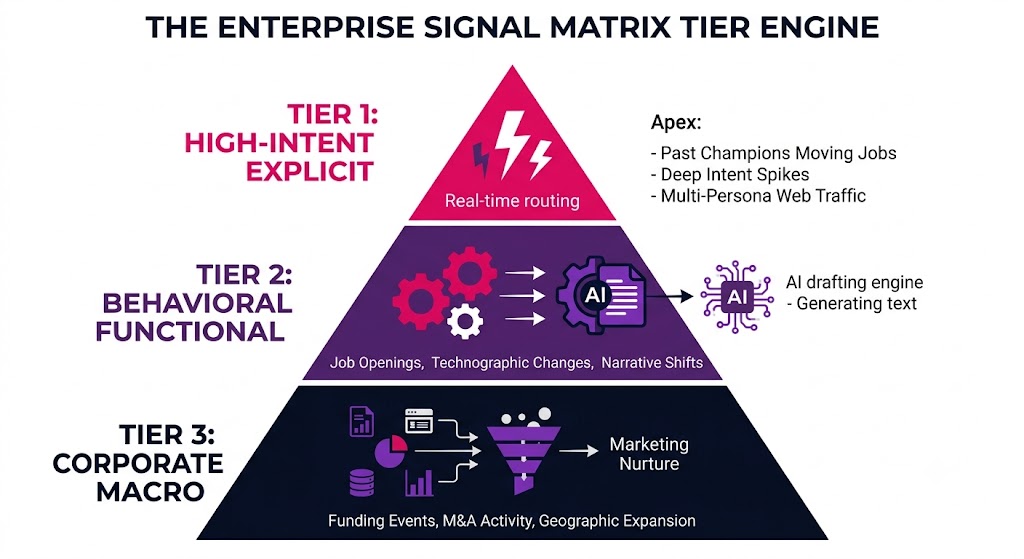
The Enterprise Signal Matrix
| Signal Tier | Indicator & Specific Data Trigger | Intent Weight | Operational System Action |
| Tier 1: High-Intent (Explicit) | • Past Champions/Power-Users Moving Jobs: A past user or historical buyer leaves a customer account and takes a leadership role at a target target account.
• Deep Third-Party Intent Spikes: An account shows an intense surge in research activity on G2, Gartner, or TrustRadius for your specific category or direct competitors. • Multi-Persona First-Party Web Traffic: 5+ distinct, un-blinded IP addresses from a target account visit your technical documentation, pricing, or security compliance pages within a 48-hour window. |
9/10 | Route directly to an assigned Account Executive (AE) or Senior enterprise SDR for immediate, highly tailored, multi-threaded human outreach within 2 hours. |
| Tier 2: Behavioral (Functional) | • Granular Job Openings: A target account publishes multiple job listings for highly specific technical or functional skills (e.g., “Senior Engineer with Snowflake optimization experience”).
• Technographic Stack Changes: Detection via web scanners that an account has uninstalled a direct competitor’s tag or integrated an adjacent platform that creates an immediate dependency on your solution. • Executive Narrative Shifts: The CEO or CFO mentions a highly specific strategic priority, operational challenge, or digital transformation goal during an annual earnings call, quarterly report, or public industry panel. |
6/10 | Feed data automatically into your AI SDR tool (e.g., CosGen) to research the account context, extract relevant snippets, and compile structured first-draft messaging for review. |
| Tier 3: Corporate (Macro) | • Capital Influx Events: Announcement of new funding rounds (Series B through late-stage growth), major corporate debt restructuring, or a large public government contract award.
• Structural M&A Activity: Active mergers, acquisitions, or corporate divestitures that force system consolidations and operational restructuring. • Geographic Expansion: Public announcement of new regional headquarters, international office rollouts, or massive localized hiring waves. |
4/10 | Place account into an automated, long-term educational nurture track managed by the marketing engine, or assign to low-priority outbound queues for baseline exploration. |
3. The Enterprise Technical Stack Architecture
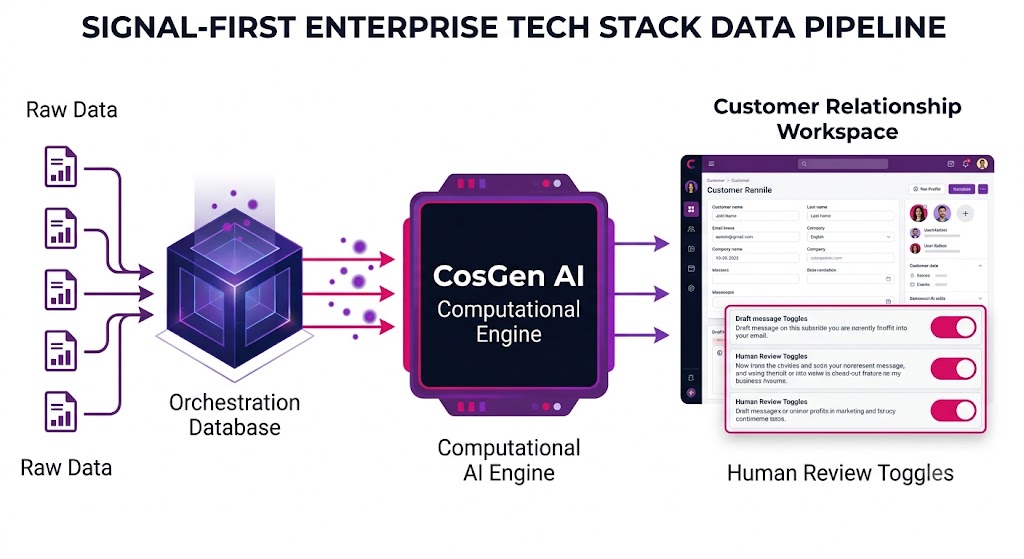
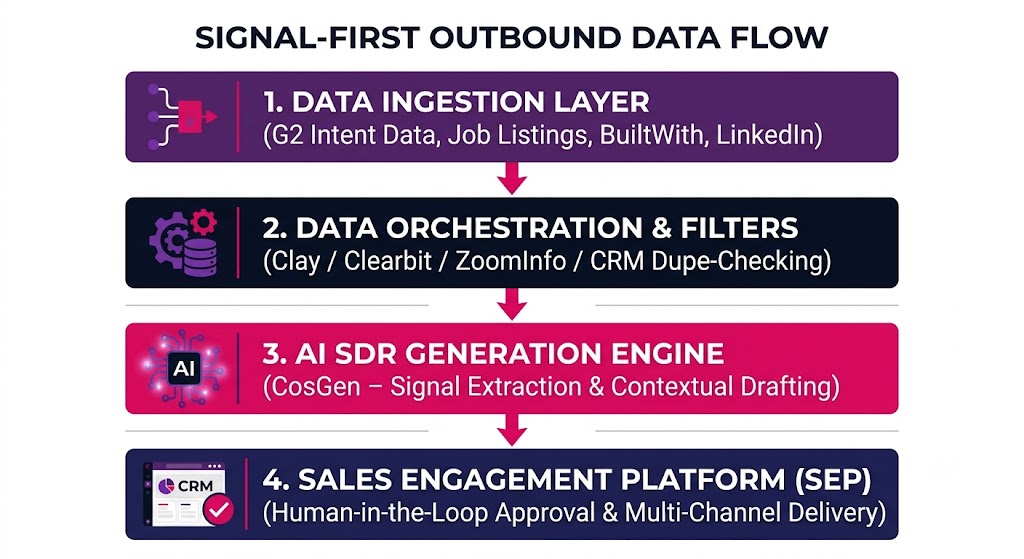
Executing this model at scale requires an integrated data layer. Trying to manage a signal-first framework manually by having SDRs browse LinkedIn or check job boards individual-by-individual is completely unviable. The modern enterprise infrastructure must connect several distinct software layers via native integrations and APIs to move a prospect from an external signal to a booked meeting.
Data Ingestion Layer
This layer continuously monitors the open web, public registries, financial reports, and proprietary data networks to catch specific event changes.
- Intent Networks: Bombora, G2 Buyer Intent, Gartner Digital Markets.
- Technographic Scanners: BuiltWith, Datanyze, HG Insights.
- Hiring & Professional Networks: PredictLeads, LinkedIn Sales Navigator, Indeed API.
Data Orchestration & Normalization Layer
Raw signals are chaotic, unformatted, and filled with noise. This layer ingests the raw data stream, applies strict ICP filters, deduplicates accounts against your existing CRM, and maps out dependencies. Advanced pipeline setup requires structured deployment of data science and analytics architectures. Platforms like Clay or Census act as central orchestration hubs here, letting you build complex data logic tables that combine multiple APIs into a single workspace.
AI SDR & Personalization Layer
Once a clean, filtered signal is isolated, it lands in the intelligence layer. Tools like CosGen (Cosnet’s AI sales agent engine) parse the signal text, reference your internal product training documentation, match the persona of the target buyer, and draft highly customized outreach assets.
Sales Engagement & Execution Layer
The final layer manages the actual physical delivery channels (Email, LinkedIn API, or automated dialer queues). Platforms like Outreach, Salesloft, or Apollo handle delivery logic, track domain deliverability, map reply analytics, and sync all historical activity directly back to the system of record—your CRM (Salesforce or HubSpot).
4. Step-by-Step Implementation Guide
Setting up an enterprise signal-first architecture requires methodical, step-by-step engineering. Rushing directly into writing automated prompts before locking down data validation or domain infrastructure will result in severe technical issues, such as blacklisted sender profiles or highly inaccurate AI messaging. Follow this sequence precisely to build a stable system.
1.Map Core Logic & Build the Orchestration Workspace: (Weeks 1-2)
Create a centralized workflow inside your data orchestration engine (e.g., Clay). Build filters that immediately reject any incoming signal that falls outside your core Enterprise ICP. Filter out any company with less than $50M in revenue, accounts in unsupported geographic regions, or companies with active, open opportunities currently assigned to Account Executives in your CRM.
2.Isolate and Configure Outbound Domain Architecture: (Infrastructure Safeguard)
Never send cold, automated, or signal-driven outreach from your primary corporate email domain (e.g., company.com). If an influx of automated tracking flags occurs, your entire internal corporate communication structure can go down. Purchase 3–5 dedicated outreach domains (e.g., getcompany.com, companylabs.io). Configure all DMARC, DKIM, and SPF security records perfectly. Connect these accounts to automated domain warm-up platforms for a minimum of 21–30 days before sending a single outbound email.
3.Deploy Real-Time Signal Listeners: (Data Engineering)
Hook up live API extractions to pull active data changes into your workspace. For a behavioral hiring track, build a listener that extracts daily job posts containing key functional responsibilities. Ensure the tool isolates the exact text block describing why they are hiring for that role, as this text will serve as the essential context anchor for your AI engine.
4.Configure Multi-Source Waterfall Enrichment Layers: (The Waterfall Process)
A single data provider rarely holds accurate information for every single market segment. To maximize data coverage and minimize decay, set up a sequential data waterfall. If Data Provider A cannot find a verified mobile number or work email for a specific VP of Engineering, your workspace must automatically route the query to Data Provider B, and then Data Provider C, running live validation checks until a high-confidence, non-catchall email is secured.
5.Integrate the AI Prompt Context Framework: (Prompt Engineering)
Connect your validated data rows to your AI SDR generation engine (e.g., CosGen). Provide the AI model with precise operational boundaries. Feed it three distinct data vectors: your standard corporate value proposition playbook, the exact raw text of the intent signal, and the specific LinkedIn bio text of the persona you are targetting. Instruct the model to analyze the gap between the prospect’s current signal state and your platform’s capability.
6.Deploy the 60-Second Human-in-the-Loop (HITL) Gate: (Human-in-the-Loop)
Do not allow an AI model to send fully autonomous outbound communications directly to an enterprise tier-1 target account without human oversight. Configure the output of your AI layer to push the fully compiled, multi-channel draft message straight into the task queue of your assigned account representative. The human rep reviews the text, ensures the stylistic tone matches company standards, makes any necessary hyper-local adjustments, and hits approve within 60 seconds.
5. Deconstructing the Copywriting Architecture: Legacy vs. Signal-First
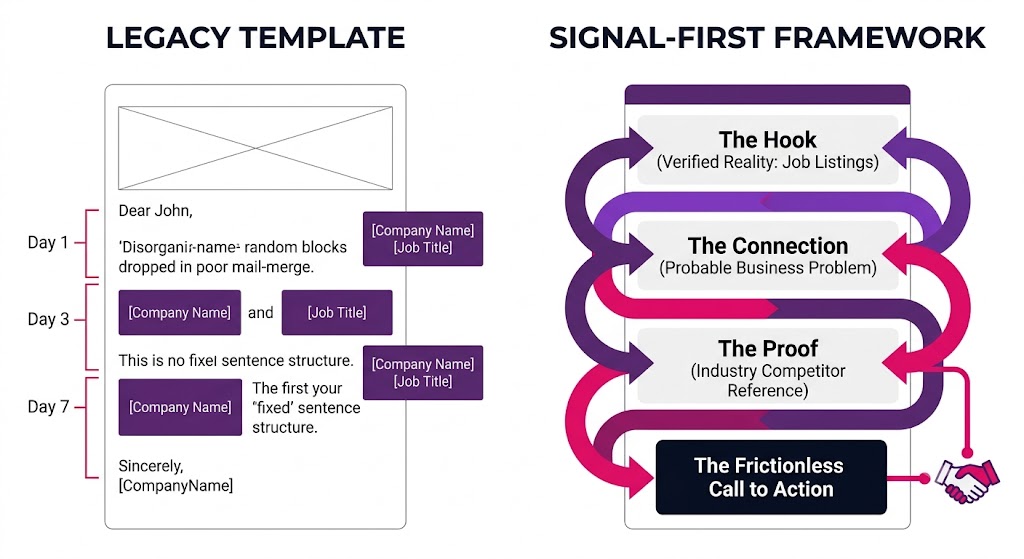
The structural design of a signal-first cold message is entirely different from a traditional outbound pitch. Traditional outbound copy uses a template that relies heavily on “mail-merge variables”—such as dropping a company name or job title into a fixed sentence structure. The prospect can instantly spot the template because the variable has no actual bearing on the surrounding argument.
In contrast, a signal-first approach weaves the detected event directly into the core thesis of the outreach. The email cannot exist without the signal; the signal forms the structural foundation of the message. To maximize conversion in modern inbox algorithms, implementing advanced Generative Engine Optimization (GEO) principles within your messaging scripts ensures clarity and high context readability.
Anatomy of a Weak Outbound Message
To see this clearly, let’s look at a traditional, template-reliant enterprise message:
Subject: Quick question for you, John
Hi John,
I see that you are the VP of Infrastructure at Acme Corp. Managing cloud infrastructure in the financial technology space can be incredibly complex.
We provide an enterprise-grade cloud cost optimization platform that helps companies like Acme reduce unnecessary resource spending. Our proprietary dashboard gives you real-time visibility into your AWS accounts.
Do you have 15 minutes next Tuesday at 2 PM to jump on a introductory Zoom call to see a live demo of our platform?
Best regards,
Outbound Rep
Why this fails: It is clearly a generic script. The mention of “VP of Infrastructure” and “Acme Corp” are simple text-replacements. The value proposition is entirely focused on the seller’s product features rather than the buyer’s current, internal reality. It forces the buyer to do the heavy mental lifting of figuring out why this matters to them right now.
Anatomy of a High-Converting, Signal-First Message
Now, let’s examine how an advanced AI SDR tool utilizes an active behavioral hiring signal to rewrite the exact same pitch, turning it into a hyper-contextual, high-value outreach asset:
Subject: Balancing DevOps scaling with AWS cost control at Acme
Hi John —
Noticed your infrastructure team recently published three separate senior engineering openings explicitly requiring expertise in managing distributed Kubernetes clusters across multiple AWS zones.
Usually, when an enterprise scales engineering velocity at that pace, cloud resource utilization spikes unpredictably before the new hires even finish onboarding. The hidden challenge is tracking down zombie infrastructure environments created during rapid development cycles.
We built a system that connects directly to your terraform files to automatically tag, monitor, and clean up idle staging environments. We helped the infrastructure team over at [Direct Industry Competitor] keep their AWS overhead flat while they doubled their overall engineering headcount last year.
I compiled a short, three-page technical brief mapping out the exact resource leakages we typically see during a Kubernetes scale-out like the one Acme is navigating. Would it be helpful if I dropped the PDF over via email?
Cheers,
Enterprise Representative
Why this succeeds:
- The Hook: The message opens with a verified operational reality (the specific job listings and their exact technical requirements). This instantly signals that the message is custom-tailored.
- The Connection: The second paragraph connects the signal directly to an invisible, highly probable business problem (spiking cloud costs and zombie environments during rapid team scaling). It demonstrates deep empathy and industry expertise.
- The Proof: It references a direct peer competitor, establishing immediate social proof and commercial relevance.
- The Frictionless Call to Action (CTA): Instead of demanding 15 minutes of a busy executive’s time for an unwanted product pitch, it offers an educational asset (a technical brief) with zero strings attached. This radically lowers the friction to reply.
6. Enterprise RevOps Metrics: Measuring True Efficiency
When moving away from high-volume, legacy outbound motions, traditional key performance indicators (KPIs) like “total emails sent” or “total calls placed” become obsolete. If your team sends 10,000 emails a month and closes zero pipeline, that volume is a net-negative metric that has actively damaged your domain reputation.
A signal-first framework requires RevOps leaders to track efficiency and conversion ratios across the entire lifecycle of an account.
1. Signal-to-Opportunity Conversion Efficiency
This metric measures the predictive quality of your individual signals. You calculate it by taking the total number of accounts that triggered a specific signal and dividing it by the number of those accounts that converted into a fully qualified sales opportunity.
Signal-to-Opportunity Efficiency= (Qualified Opportunities Created/Total Accounts Triggered by Specific Signal) x 100
Application: If your “Past Buyer Job Change” signal yields a 22% conversion rate to opportunity, while your “Series C Funding” signal yields only a 2% conversion rate, you should reallocate your AI and engineering resources away from funding events and double down on tracking executive movement.
2. HITL Platform Adoption (Draft-to-Send Ratio)
For teams operating a human-in-the-loop framework, this tracks the accuracy of your AI SDR generation engine. It measures the percentage of AI-generated outbound drafts that reps approve and send without requiring major rewrites.
Draft-to-Send Ratio = AI Drafts Approved and Sent without Major Edits/Total AI Drafts Generated for Review x 100
Application: If your Draft-to-Send ratio drops below 70%, it indicates that the AI engine lacks sufficient account context, is referencing stale data points, or its fundamental prompt parameters need to be re-aligned with your product playbook.
3. Absolute Domain Health and Sender Reputation Analytics
Because modern email deliverability is heavily dependent on user engagement, tracking infrastructure metrics is vital to ensure long-term pipeline safety.
- Spam Complaint Threshold: Must be maintained strictly below 0.1% across all alternative outbound domains. Reaching 0.3% will cause major email providers to route your communications directly into the spam folder.
- Bounce Rate Limit: Must be maintained strictly under 2%. A high bounce rate indicates that your waterfall data enrichment layer is failing to properly validate email addresses before sending.
7. Comprehensive FAQ: Navigating Signal-First Outbound
Q1: What makes a signal-first framework different from standard cold emailing?
A: Standard cold emailing relies entirely on static contact lists and sends identical, pre-written message templates to thousands of recipients based purely on generic criteria like job titles. A signal-first framework is fundamentally event-driven. It monitors the market for specific, actionable changes (such as hiring surges, technographic shifts, or buyer intent spikes) and only generates highly contextual outreach once a clear business challenge has been identified.
Q2: How do we prevent our AI SDR tools from hallucinating or generating generic emails?
A: AI hallucination occurs when a model is given an open-ended prompt without strict data boundaries. To stop this completely, you must use a structural process called Retrieval-Augmented Generation (RAG). Instead of asking the AI to “write a clever email,” you supply it with rigid data vectors: the exact text of the intent signal, verified facts about the target company, and a structured product playbook. You then apply strict programmatic constraints, such as: “You are forbidden from referencing any product feature or client case study that is not explicitly detailed in the provided training document.”
Q3: How many alternative domains should an enterprise team set up, and how much volume can they handle?
A: For a standard enterprise sales team running an active signal-first outbound motion, we recommend provisioning 3 to 5 secondary domains entirely separate from your main corporate domain. Each domain should host no more than 2 individual email inboxes. To maintain pristine domain authority and guarantee your messages consistently hit the primary inbox, each individual inbox should strictly limit its cold outbound volume to 25 to 30 emails per day.
Q4: If an automated signal fires, how quickly should our team execute outreach?
A: The value of an intent signal decays rapidly over time. For high-intent Tier 1 signals—such as a key stakeholder visiting your pricing page or a past power-user changing jobs—outreach should land in the target’s inbox within 2 to 4 hours. For Tier 2 behavioral signals like job openings or executive podcast interviews, your automated systems should ingest the data, generate the contextual draft, and surface it to your human rep’s review queue within 24 hours.
Q5: Can we run a signal-first framework across other communication channels besides email?
A: Yes. A true enterprise framework should be completely multi-channel. When an intent signal fires, the orchestration layer should build a synchronized sequence across multiple touchpoints. For example, Day 1 could feature a highly contextual cold email referencing the signal; Day 2 involves an automated task for a human rep to drop a value-first comment on the prospect’s recent LinkedIn post; and Day 4 triggers an automated cold call task where the rep highlights the exact same core challenge.
Q6: How do we handle situations where an account triggers multiple signals at the same time?
A: Your data orchestration layer must be configured with a clear, automated prioritization hierarchy. If an account simultaneously triggers a Tier 3 signal (e.g., announcing a new office location) and a Tier 1 signal (e.g., their engineering team is surging on your direct competitor’s G2 comparison page), the orchestration workspace should instantly suppress the Tier 3 messaging track. The system upgrades the account into the high-priority Tier 1 human execution queue, ensuring your team leads with the highest-converting intent hook available.
Q7: How deeply do modern AI SDR tools integrate with traditional enterprise CRMs like Salesforce or HubSpot?
A: Advanced AI SDR agents like CosGen feature deep, bidirectional API integrations with major CRM platforms. The tool does not operate in isolation; it checks your CRM logs before executing any task. It continuously validates that an account does not have an active open opportunity, isn’t tagged as an active customer, and isn’t currently assigned to an ongoing account-based marketing (ABM) sequence. Once the AI handles a positive reply, it logs the complete interaction history, maps the contact records, updates the stage classification, and sends a direct Slack notification to the assigned sales representative.