

Your competitor’s sales team just responded to a lead at 11:47pm. They did not hire night-shift reps. They did not pay overtime. They deployed an AI sales agent and it responded, qualified the lead, and booked the meeting before your team opened their laptops the next morning. That is not a hypothetical. It is the operational reality separating the top 10% of B2B sales teams from everyone else in 2026. The same shift toward agentic AI for business that is reshaping operations across every department has hit sales hardest — because the stakes are the most visible and the ROI is the most measurable.
This is not a guide about what an AI sales agent is in theory. It is about what is actually working, what is not, and what real B2B teams are doing differently.
The Number That Should Make Every Sales Leader Uncomfortable
60% of sales reps’ time goes to non-selling tasks hunting for pitch decks, manually entering notes, chasing unresponsive leads — according to Salesforce State of Sales 2026.
Read that again. The majority of what your sales team is paid to do is not selling.
Meanwhile, sales teams using AI tools are 3.7 times more likely to meet quota than those that do not. That gap is not closing it is widening with every quarter that passes.
The businesses closing that gap are not necessarily bigger, better-funded, or in easier markets. They have simply stopped asking their salespeople to do the work that a machine does better — volume prospecting, research, first-touch outreach, follow-up sequences — and redirected human attention to the work machines cannot do: relationships, judgment calls, and closing.
What an AI Sales Agent Actually Does at 11:47pm
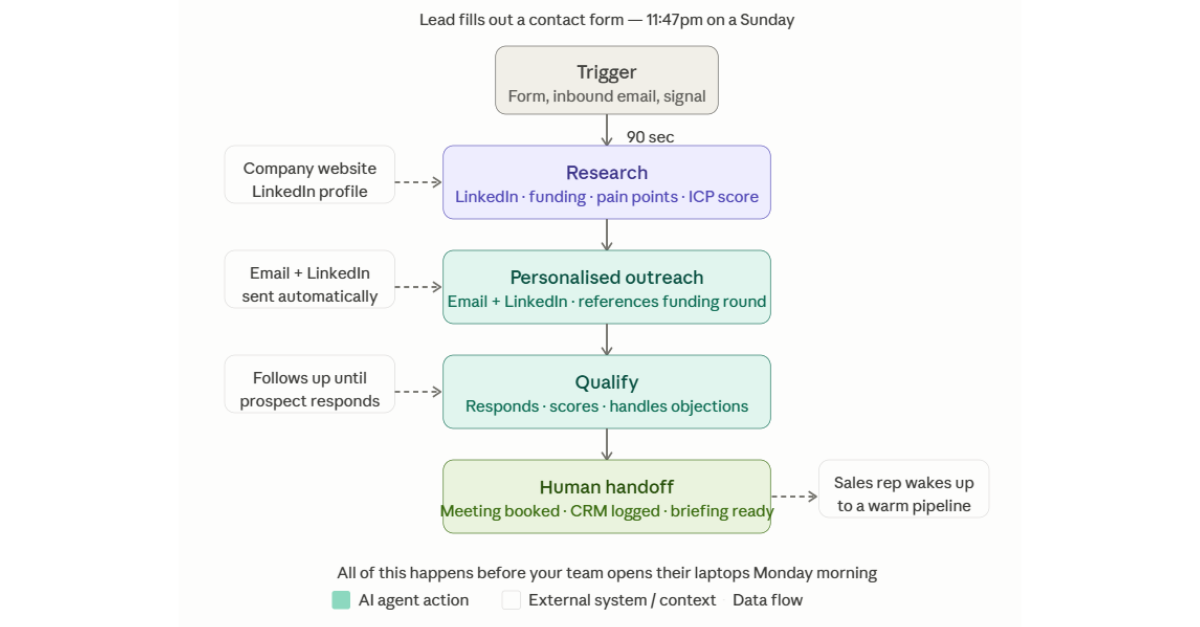
Here is a concrete sequence. A CFO at a 200-person SaaS company fills out a contact form on your website. It is a Sunday evening.
A human sales team: the lead sits in the CRM until Monday morning, gets picked up by whoever opens their inbox first, receives a generic follow-up email by Tuesday if they are lucky.
An AI sales agent: within 90 seconds of form submission, the agent has looked up the CFO’s LinkedIn profile, found the company’s recent funding announcement, identified two mutual connections, drafted a personalised opening message referencing the funding round and a specific pain point relevant to their company size, sent it via LinkedIn and email, logged the full interaction to the CRM, and flagged the lead as high-priority for the sales rep on Monday morning — along with a briefing document.
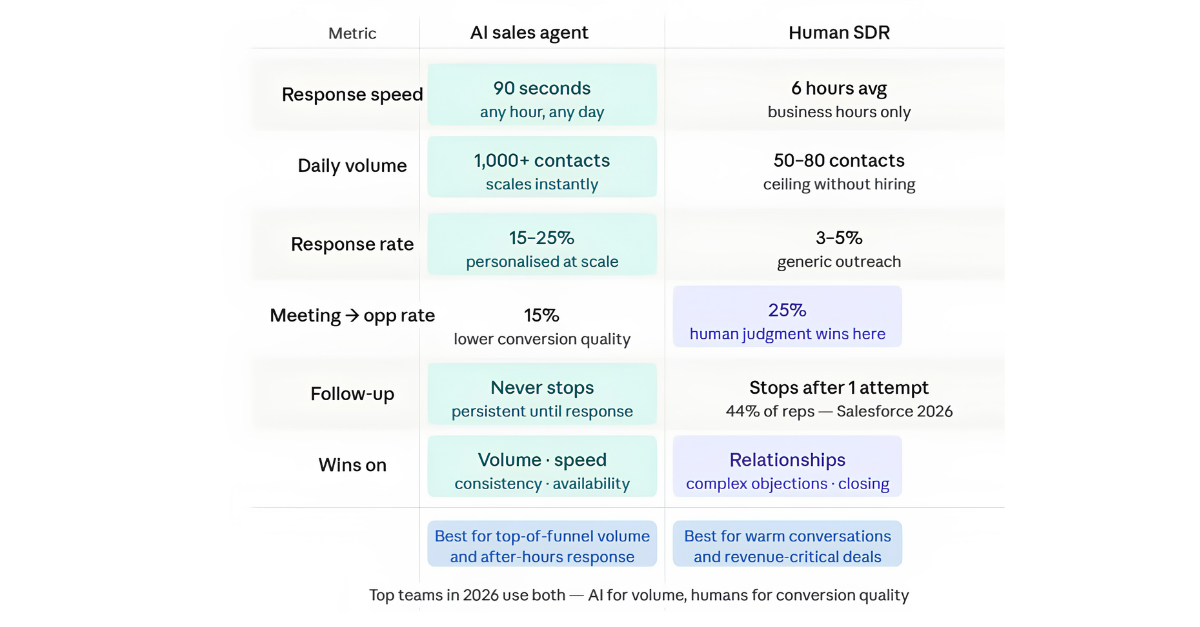
First responders win deals at 5 times the rate of slower competitors. And 44% of human reps give up after one attempt — an AI sales agent never stops following up.
Those two facts together explain most of the pipeline gap between AI-enabled and non-AI-enabled sales teams. The businesses on the right side of that gap did not get there by having bigger budgets or better products. They got there by stopping the waste.
The Results Real Teams Are Seeing — With the Honest Caveats
The numbers coming out of production AI sales agent deployments in 2026 are strong. They are also frequently overstated in vendor marketing. Here is what peer-reviewed data and independent research actually shows.
Personalised outreach from AI sales agents achieves 15% to 25% response rates, compared with 3% to 5% for traditional generic approaches. That is a genuine 5x improvement — but it requires the agent to be running on a well-defined ideal customer profile and clean contact data. An agent running on a vague ICP and a stale list will not produce these numbers.
AI-based lead scoring improves conversion rates by up to 51%, and organisations implementing AI agents report 7% to 25% revenue gains.
The honest caveat: AI sales agents convert meetings to opportunities at around 15%, versus 25% for skilled human SDRs — a 40% conversion quality gap that closes with better training but does not disappear entirely.
The takeaway is not that AI replaces human SDRs. It is that AI handles the volume work — prospecting, outreach, initial qualification — so human SDRs can focus exclusively on the conversations where their judgment and relationship skills actually produce the conversion quality that machines cannot replicate.
Three Live Examples From Real B2B Teams
The insurance broker that stopped losing Monday morning leads
A mid-size commercial insurance brokerage was losing a measurable percentage of their inbound leads every weekend. Prospects filled out forms on Saturday, received no response until Monday, and had already spoken to two competitors by then. After deploying an AI sales agent to handle weekend inbound, their Monday morning pipeline arrived pre-qualified, with meetings already booked. The leads that previously went cold were converting at the same rate as weekday leads.
The SaaS team that 10x’d their outbound capacity without hiring
A 15-person B2B SaaS company was generating 80 to 100 personalised outreach sequences per week with their two-person SDR team. After deploying an AI sales agent for prospect research and first-touch drafting — with humans reviewing and sending — they moved to 800 to 900 sequences per week. Same headcount. The human SDRs stopped doing research and started doing what they were actually good at: handling responses and converting conversations to meetings.
The consulting firm that fixed its follow-up problem
A management consulting firm had a chronic follow-up problem. Proposals went out, prospects went quiet, and the partners were too senior to chase unresponsive leads. An AI sales agent was deployed specifically for follow-up sequences — not prospecting, not outreach, just follow-up on open proposals. Pipeline visibility improved immediately. Several deals that would previously have been quietly lost were reopened through persistent, contextually relevant follow-up that no human was doing consistently.
What Separates a Deployment That Works From One That Doesn’t
Gartner predicts over 40% of agentic AI projects will be abandoned by 2027. The failure rate is high, and the causes are almost always the same.
A vague ideal customer profile is the single biggest killer: AI amplifies whatever targeting logic it is given. A vague or overly broad ICP produces high volumes of low-quality outreach that damages deliverability and generates poor buyer experiences. Before any agent is deployed, the ICP needs to be specific enough that a junior sales rep could immediately tell whether a prospect fits it or not.
Dirty data is the second: B2B contact data decays at 2.1% per month — meaning a large share of any database becomes unreliable within a year. An AI sales agent running on outdated contact data does not fix that problem — it contacts the wrong people faster. A clean first-party data strategy is the prerequisite, not the afterthought.
No governance is the third: Every AI sales agent sending outreach on behalf of your brand needs defined sending limits, logged actions, and clear escalation triggers. The shadow IT and AI governance challenges that surface in enterprise AI deployments show up in sales agent deployments too — particularly around data handling, consent compliance, and brand reputation. Build the controls before the agent goes live, not after something goes wrong.
Scope creep is the fourth: The agent that prospects, qualifies, sends proposals, handles objections, and manages the post-sale process does all of them poorly. One stage of the funnel, one agent, one measurable outcome. That is the architecture that ships and performs.
The Connection Most Sales Teams Are Missing
There is a dimension of AI sales agents that rarely appears in sales technology conversations but is becoming commercially significant in 2026.
Around 89% of B2B buyers now use generative AI as a key information source before engaging a vendor — per Forrester’s B2B Buying Study 2026.By the time a prospect responds to your AI sales agent’s outreach, there is a strong probability they have already asked ChatGPT, Perplexity, or Gemini about your company, your competitors, and the problem you solve.
If your brand appears in those AI-generated answers — if generative engine optimization has done its job — your AI sales agent is reaching out to prospects who already have context, already have positive brand recognition, and are measurably warmer than cold outreach would suggest. If your brand does not appear in those answers, your agent is working significantly harder to establish credibility from scratch.
AI sales agents operate at the outreach stage. GEO operates at the awareness stage. Together they close the loop between being found and being engaged — and the businesses building both simultaneously are the ones seeing the compounding returns.
FAQs
Will an AI sales agent replace my SDR team?
The evidence consistently shows no — but it will change what your SDRs spend their time doing. AI handles volume, speed, and follow-up consistency. Humans handle conversion quality, complex objections, and relationship-building. The highest-performing teams in 2026 are the ones that have clearly divided this work — not the ones trying to automate everything or the ones refusing to automate anything.
What results can we realistically expect in the first 90 days?
Faster response times and higher outreach volume are visible almost immediately. Response rate improvements — typically moving from 3–5% on generic outreach to 15–25% on AI-personalised outreach — become measurable within 30 to 60 days if the ICP is well-defined and data is clean. Pipeline volume improvements show up at 60 to 90 days. Meeting-to-opportunity conversion rates take longer to optimise and depend heavily on how clearly the handoff to human SDRs is structured.
Which workflow should we give an AI sales agent first?
Weekend and after-hours inbound response is the highest-impact, lowest-risk starting point for most teams — there is no human doing this work currently, so there is no displacement and immediate measurable improvement. Cold outbound prospecting for a specific ICP segment is the second. Follow-up sequences on open proposals or cold conversations is the third. Start with one, measure it properly, then expand.
How long does deployment take?
A focused single-workflow AI sales agent — scoped to one ICP, one channel, one stage of the funnel — typically takes four to eight weeks from scoping to production. The timeline extends when ICP definitions are vague, CRM data requires cleaning, or integrations with existing systems are complex. The teams that try to deploy everything at once consistently take longer and produce worse results than teams that start narrow.
What is the biggest mistake teams make when deploying one?
Deploying before the ICP is defined precisely enough for the agent to make targeting decisions. The second biggest mistake is treating it as a replacement for human relationship skills rather than a complement to them. The third is skipping governance — sending limits, logged actions, human review checkpoints — until something goes wrong with a high-value prospect.
Ready to build an AI sales agent for your pipeline?
Cosnet builds AI agent systems that slot into your existing CRM, data, and sales workflows — from single-workflow sales agents to full multi-agent architectures. Scoped correctly, governed properly, and built for production.
Talk to our team about how to build your first AI agent from ICP definition to live deployment.
