

Most B2B sales teams do not struggle because they lack prospects. They struggle because too much of the sales process happens before a real conversation ever starts. Reps spend hours researching companies, checking contacts, writing outreach, updating CRM records, and following up with leads who may never reply. This is where AI SDR (Sales Development Representative) tools and AI sales agents are fundamentally reshaping how modern sales teams build pipelines.
In simple terms, an AI SDR tool helps B2B sales teams automate prospect research, personalized outreach, follow-ups, and lead qualification. Crucially, it does not replace the entire sales team. Instead, the highest-performing use case is helping reps spend less time on repetitive data work and more time on real, high-value conversations.
But how exactly are these tools altering the B2B landscape in 2026—and what should businesses understand before adopting one?
Evolution: The Shift from Legacy Outbound to Advanced AI
To understand why AI SDR tools have become a necessity, we have to look at how the B2B sales process itself has structurally broken down and evolved over the last decade.
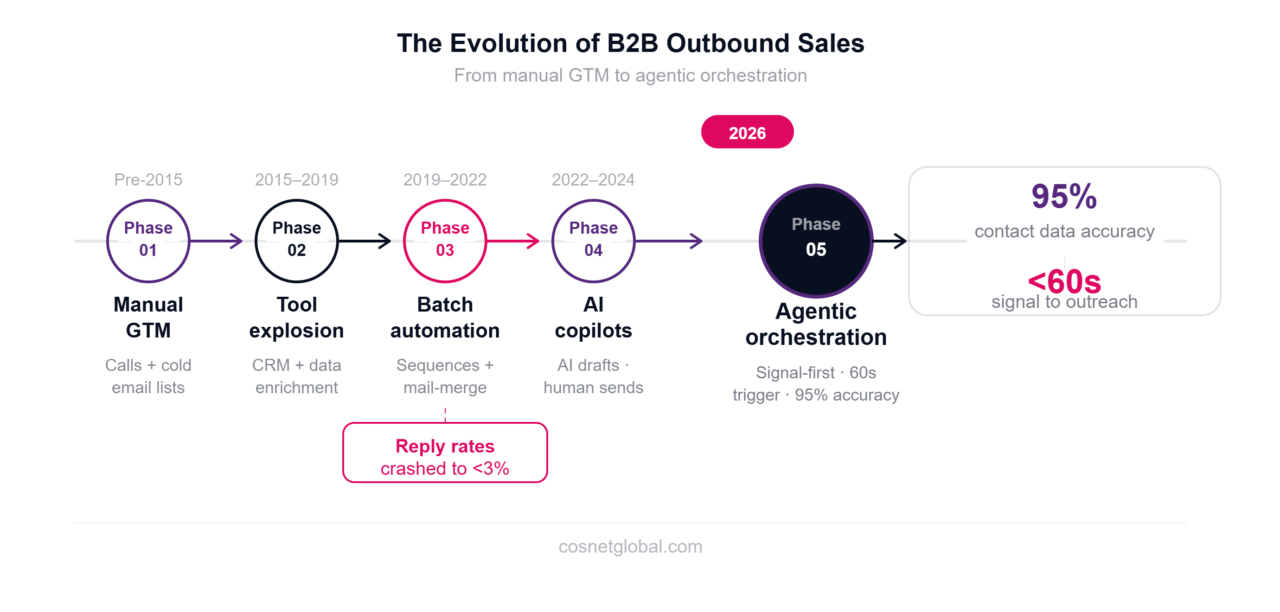
- The Old Way (Legacy Automation): For years, outbound sales operated on a basic equation: more volume = more pipeline. Teams connected data scraping tools to email sequencers, triggering automated “batch-and-blast” email campaigns. The problem? It optimized for output over intelligence. By 2024, average email reply rates plummeted below 3% because buyers became entirely numb to generic, templated mail-merges.
- The Advanced AI Way (Signal-First Orchestration): In 2026, the B2B sales stack has moved from fragmented automation into a unified, agentic ai era. Advanced AI SDR tools no longer just “write faster emails.” They pull from multi-source waterfall enrichment architectures (dynamically combining 100+ data sources to achieve 95% contact data accuracy) and execute signal-first prospecting. Instead of a static list, outreach is triggered automatically within 60 seconds of an account showing a real buying signal.
Industry Specific B2B Sales Processes
AI SDR tools are not one-size-fits-all. Their architecture changes entirely based on the complexity, deal cycle, and target audience of your specific industry.
1. High-Volume, Low-ACV (Annual Contract Value) Technology
In industries with smaller deal sizes (under $25,000) and shorter sales cycles (less than 30 days), the process prioritizes speed and sheer scale. The AI monitors a broad Ideal Customer Profile (ICP), auto-enriches data, and manages multi-channel outreach across email and social platforms to book meetings directly into a representative’s calendar.
2. Complex Enterprise SaaS & Professional Services
For long-cycle, multi-stakeholder enterprise deals ($100K+ ACV), a high-volume approach destroys brand reputation. Here, the sales process shifts to multi-threaded deal management. The AI’s job is deep research—mapping out multiple stakeholders (the economic buyer, technical evaluators, and end-users) and identifying highly specific technical stack gaps or structural hiring surges before a human ever reaches out.
3. Industrial Manufacturing & Logistics
In traditional supply-chain environments, buyers expect immediate responses but operate on rigid, codified logic. Here, AI tools act as inbound and outbound transaction layer engines, validating incoming commercial requests against active pricing sheets, inventory systems, and enterprise resource planning (ERP) software without forcing an operator to open an Excel sheet.
How an AI SDR Tool Actually Works (Step-by-Step)
Every advanced AI SDR tool—whether fully autonomous or human-assisted—follows a highly synchronized operational sequence under the hood to transition a cold account into an active opportunity.
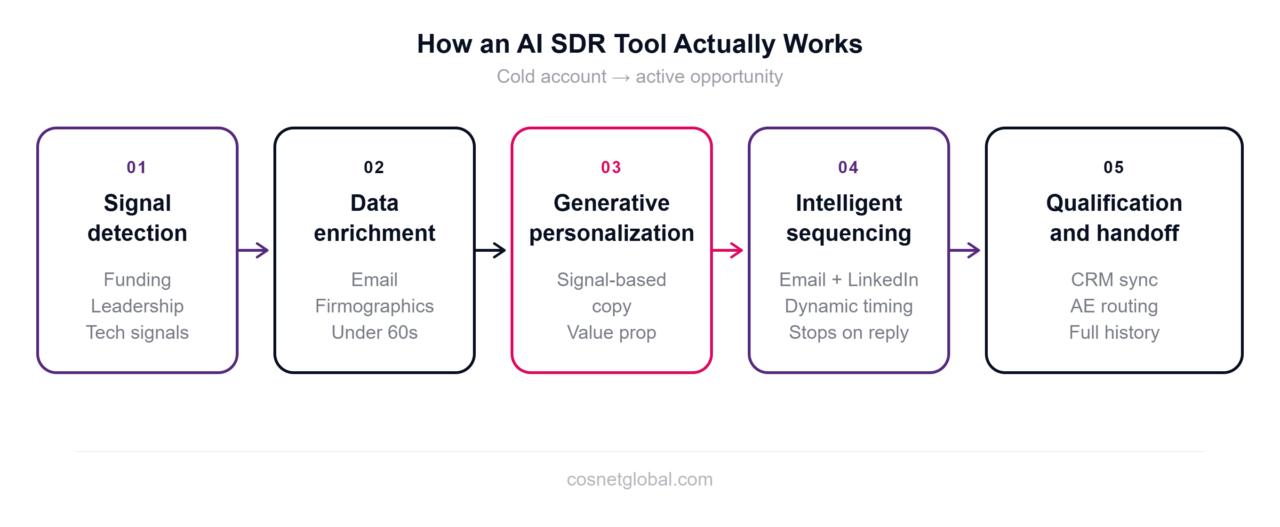
1. Signal Detection: Instantaneous Trigger.
The platform continuously monitors external data graphs for active buying windows: recent funding announcements, executive leadership changes, specific job postings indicating a function is scaling, or technology adoption changes.
2. Waterfall Data Enrichment: Collapsing to <60 Seconds.
The moment a signal fires, the system cross-references multiple data providers. It resolves verified email addresses, mobile numbers, and contextual firmographics (company size, growth velocity, current tech stack) to ensure zero reliance on a single, stale database.
3. Generative Personalization: Context-Grounded Copy.
Using the enriched context, the AI writes a highly specific opening line and value proposition. It doesn’t rely on basic text replacement; it builds an argument linking the detected signal directly to how your product solves that explicit problem.
4. Intelligent Sequencing: Multi-Channel Cadence.
The AI distributes and spaces touchpoints logically across Email and LinkedIn. It adjusts follow-up timing dynamically based on digital engagement signals (e.g., website visits) and halts the entire sequence the millisecond a human reply lands in the inbox.
5. Qualification & Handoff: CRM Synchronization.
The AI parses the reply. Out-of-office and opt-outs are handled automatically, while high-intent responses are classified immediately. The qualified prospect, along with the entire interaction history, is sync
Autonomous vs Assisted AI SDR Tools: Which Is Better?
The sales market has split into two distinct operational philosophies regarding how much control should be handed over to an artificial agent.
Feature / Dynamic |
Autonomous AI SDR (“Replace the SDR”) |
Assisted AI SDR / Copilot (“Amplify the SDR”) |
|
Primary Focus |
Maximum throughput, end-to-end automation. |
Deep context, data orchestration, workflow efficiency. |
|
Qualification |
Fully AI-handled via automated chat or conversational email. |
Human-led; AI surfaces the lead, human builds the bridge. |
|
Relationship Building |
Limited; struggles with nuanced, multi-threaded human dynamics. |
Strong; leaves the trust-building and strategic closing entirely to reps. |
|
Platform / Deliverability Risk |
High; unmonitored mass-outreach can trigger spam filters or social blocks. |
Low; human gating maintains premium sender reputation and brand safety. |
|
Best Suited For |
Broad ICPs, transactional sales, low-ACV industries. |
Complex B2B motions, enterprise accounts, long sales cycles. |
For many mid-market and enterprise B2B teams, the assisted model (or “human-in-the-loop” framework) delivers a far higher return on investment per dollar. Industry benchmarks indicate that hybrid pods combining human strategic judgment with AI research capabilities generate up to 1.9x more meetings per dollar than fully isolated, autonomous setups.
This hybrid balance is precisely why platforms like CosGen (Cosnet’s AI SDR product) focus on automating the heavy research, data enrichment, and initial draft creation layers, while intentionally leaving final qualification, personal tone adjustment, and relationship handling completely in the hands of your sales professionals.
What to Look for Before Adopting an AI SDR Tool
Before committing capital to an AI prospecting tool, sales operations and RevOps leaders must audit platforms using questions that separate real GTM infrastructure from a shallow software wrapper:
- Signal Integrity: Does the tool personalize based on deep, multi-source behavioral intent data, or is it just a basic mail-merge tool utilizing extra generative AI tokens?
- The Handoff Envelope: Exactly where does the autonomous loop stop and the human handoff occur? Is this threshold fully configurable based on tier-1 vs tier-3 accounts?
- Infrastructure and Deliverability Safeguards: How does the platform protect your domain authority? Does it handle automated inbox rotation, health monitoring, and immediate back-offs if spam flags rise above 0.3%?
- Data Decay Resilience: Does it pull from static, cached internal tables, or does it execute real-time, live validations at the moment of outreach execution? The quality of your first-party data directly determines how well any AI SDR tool can personalize and qualify at scale.
FAQs: AI SDR Tools
What is an AI SDR tool?
An AI SDR tool is software that automates the core operational work of a Sales Development Representative—specifically prospect data sourcing, multi-layered enrichment, personalized email/social outreach, and automated follow-up sequences.
Do AI SDR tools completely replace human sales reps?
Generally, no. While a small percentage of transactional, high-volume teams utilize them as end-to-end replacements, the vast majority of successful B2B organizations deploy AI tools to eliminate administrative drift, allowing human reps to focus entirely on live meetings and relationship closing.
How do these tools personalize outreach without sounding robotic?
Instead of simply dropping a name or job title into a blank slot, advanced engines read raw signal context (like an interview quote from an earnings call or a specific software change) and construct a customized narrative explaining why the message matters right now.
What happens when a prospect replies to an AI SDR?
In autonomous platforms, the AI attempts to handle basic objections and suggest booking links. In assisted or copilot models, the tool instantly flags the positive response, synthesizes the conversation history, and hands it directly to a human rep to step in and secure the relationship.